





Iran Refuses Talks with US for Now, Casting Doubt on Pakistan’s Peace Efforts
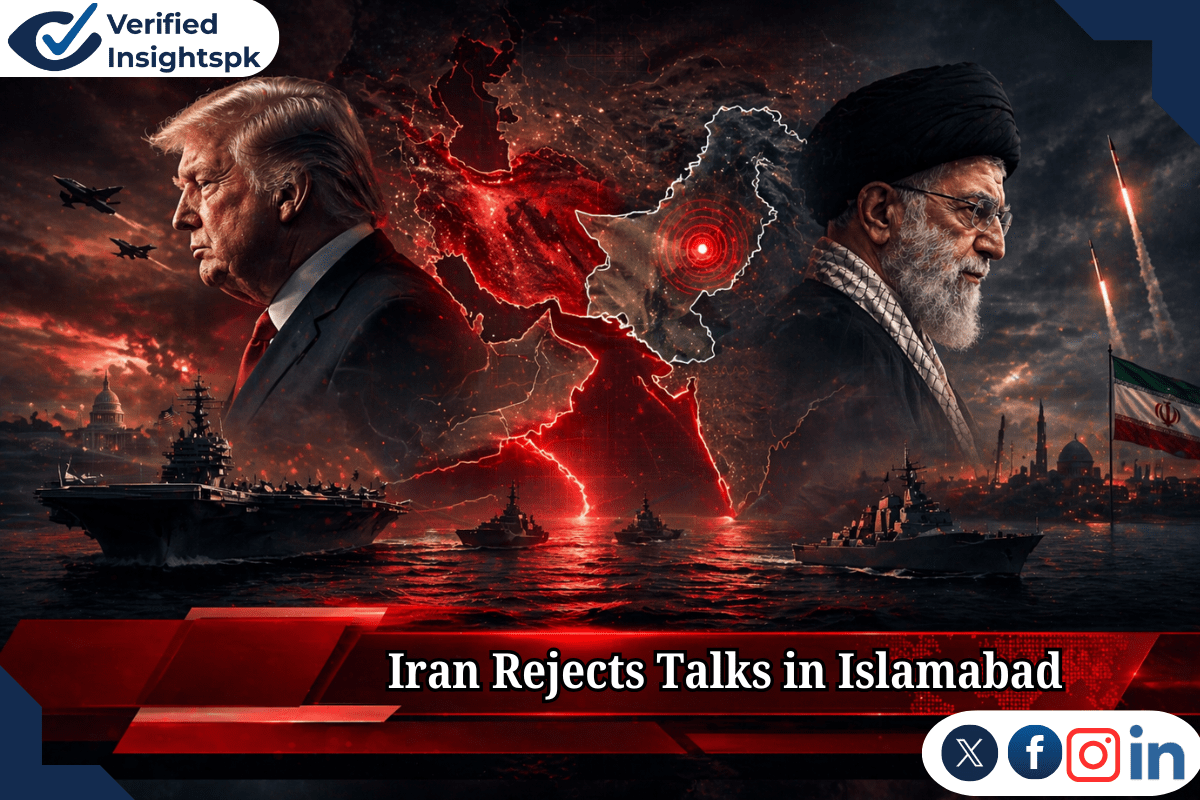
Rising tensions threaten a second round of negotiations in Islamabad. Efforts to restart peace talks between the United States and Iran in Pakistan are facing serious uncertainty. Iran has clearly said it will not send negotiators to Islamabad for now. This decision comes just days before a fragile ceasefire is set to expire.
The development is a major setback for Pakistan, which has been actively trying to bring both countries back to the negotiation table after earlier talks failed to produce a deal.
Iran blames the US for ceasefire violations
Iran’s Foreign Ministry spokesperson Esmaeil Baghaei said that the United States violated the ceasefire from the beginning. He pointed to several actions, including:
- The US naval blockade of the Strait of Hormuz
- The capture of an Iranian cargo ship
- Continued military pressure in the region
Baghaei warned that such actions are against international law and damage trust between the two sides.
He also stated that Iran will respond strongly if any new aggression takes place.
Pakistan still hopeful for diplomacy
Despite the tension, Pakistan is still trying to keep diplomatic efforts alive. Officials in Islamabad say they remain cautiously hopeful that talks can still happen.
Prime Minister Shehbaz Sharif has been actively engaging regional leaders. He recently spoke with Iran’s President and shared updates on his diplomatic visits to Saudi Arabia, Qatar, and Türkiye.
Pakistan’s goal is clear. It wants both sides to agree on a temporary understanding that can extend the ceasefire and open the door for a long-term peace deal.
US pushes for quick agreement
US President Donald Trump has taken a strong stance. He announced that US representatives would travel to Pakistan for talks. At the same time, he warned Iran of serious consequences if it does not agree to US terms.
Trump accused Iran of violating the ceasefire and said:
- The US could target Iran’s energy and infrastructure if tensions escalate
- Military pressure will continue if diplomacy fails
His statements have increased uncertainty around the negotiations.
Strait of Hormuz remains key issue
One of the biggest problems in the talks is the Strait of Hormuz. This narrow waterway is critical for global oil supply.
Key points of disagreement include:
- Iran wants control and possibly transit fees
- The US demands free and open shipping routes
- The US has imposed a naval blockade in the area
This issue alone has made it difficult for both sides to reach any agreement.
Confusion over second round of talks
There is still confusion about whether the second round of talks will happen at all.
Iran has publicly denied plans to participate. However, some reports suggest that behind the scenes, communication between both sides is still ongoing through Pakistan.
Experts say this could be a strategy:
- Publicly, Iran is taking a strong position
- Privately, it may still be open to negotiations
This dual approach is common in complex international conflicts.
Islamabad on high alert
Pakistan had already started preparing for the talks before Iran’s refusal.
Security measures in Islamabad were increased:
- Major hotels were cleared for delegations
- Roads in the Red Zone were sealed
- Thousands of security personnel were deployed
These steps show how seriously Pakistan is taking its role as a mediator.
Pakistan’s growing role as mediator
Pakistan has emerged as a key diplomatic bridge between the US and Iran.
Army Chief Asim Munir recently visited Tehran carrying messages from Washington. This shows that communication channels are still open.
Analysts believe Pakistan has gained trust from both sides because:
- It maintains balanced relations
- It has avoided taking sides publicly
- It is focused on regional stability
However, its success depends on whether it can deliver results.
Ceasefire extension may be the only realistic goal
Experts say a full peace deal is unlikely in the short term. Instead, the focus is on a smaller and more achievable goal.
That goal is:
- Extending the current ceasefire
- Creating a framework for future talks
Even this limited progress would be considered a success under current conditions.
Iran insists on its conditions
Iran has made its position clear. It wants:
- An end to US sanctions
- Control over its nuclear program
- Broader regional ceasefire guarantees
- Respect for its sovereignty
Iran has also called US demands “excessive” and unrealistic.
US demands remain strict
The United States is not backing down either. Its key demands include:
- Iran must abandon nuclear weapon ambitions
- Restrictions on uranium enrichment
- Reopening of global shipping routes
- Limits on missile programs
These strict conditions are one of the main reasons talks have stalled.
Global impact of the conflict
The ongoing tension is affecting the entire world.
Major impacts include:
- Rising oil prices due to Hormuz tensions
- Risk to global shipping routes
- Economic uncertainty in multiple regions
- Increased military presence in the Middle East
Experts warn that if the situation worsens, it could lead to a wider regional crisis.
What happens next?
The future of US-Iran talks remains uncertain.
Possible scenarios include:
- Talks resume in Islamabad after behind-the-scenes diplomacy
- Indirect negotiations continue through intermediaries like Pakistan
- Ceasefire collapses, leading to renewed conflict
For now, all eyes are on Pakistan’s efforts to bring both sides back to dialogue.
Conclusion
Iran’s refusal to join talks has created a major obstacle for peace efforts. At the same time, ongoing communication suggests diplomacy is not completely over.
Pakistan continues to play a critical role as a mediator. Whether it can succeed depends on how flexible both the US and Iran are willing to be in the coming days.
The situation remains tense, but the possibility of dialogue still exists.
More Related Topics To Read:
Historic US-Iran Peace Talks Begin in Islamabad: Everything That Happened on April 11, 2026
US-Iran Talks Fail in Islamabad After 21 Hours as Both Sides Blame Each Other
Iran War Nears End? Trump Signals Breakthrough as Pakistan Pushes New US-Iran Talks