







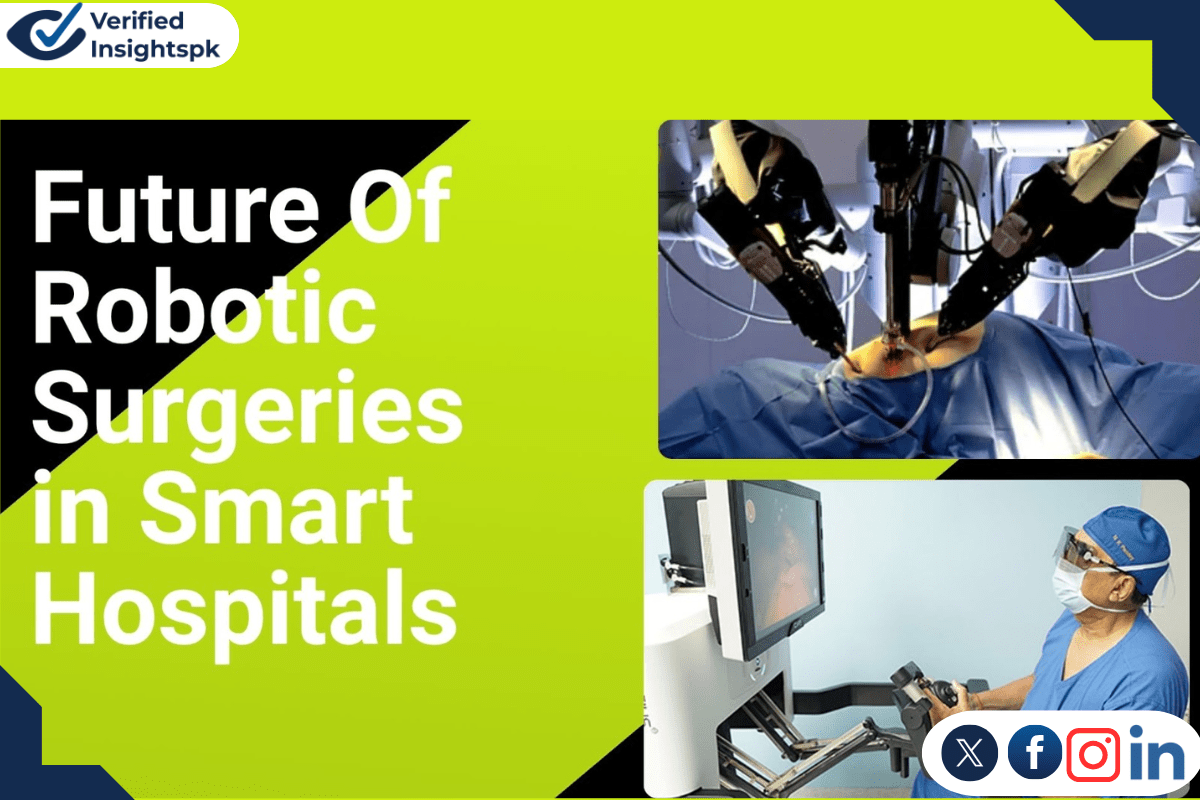
Future Of Robotic Surgeries in Smart Hospitals
As technology developed, it also brought rapid changes to the healthcare industry. One of the biggest changes is robotic surgery and smart hospitals. Many hospitals now use robotic surgery by using advanced machines to perform accurate surgery. They are controlled by using computers, and the robot arms make movements and perform operations.
However, regarding it, surgeries are so expensive, but they allow surgeons or doctors to perform difficult surgeries more safely. It also reduces the pain, blood loss, and recovery time for the patient. For robotic surgery doctor need special training related to robotics and computer systems.
In the future, robotic surgery will become so common in smart hospitals. Hospitals will use digital system AI to make healthcare safer for the patient.
In this article, we will explore what robotic surgery is, how it works, its benefits, and its limitations in the future of robotic surgery in the healthcare system.
What Is Robotic Surgery?
Robotic surgery is a modern medical technique in which doctors use robots to perform different surgeries. A robotic surgeon uses very small cuts instead of a large one. Robotic surgery is not done by the robots themselves; the robot is controlled by a doctor through a computer. The robot copies the doctor’s hand movement and performs a successful study and operation.
Robotic surgery helps surgeons to perform operations with better accuracy and less risk. This type of surgery is used in heart surgery, ophthalmology, gynecology, and related surgery. In this type of surgery, the patient usually experiences pain and slow recovery. By using robots, patients can experience less pain and small scars, and a fast recovery happens.
Robotic surgery manufacturers are working to improve their systems every day to make the surgery safer and more advanced. As with the growth of technology, robotic surgery is becoming an important part of the healthcare environment, and it is helping doctors to treat patients in a more advanced way.
Step-By-Step Guide to Robotic Surgery
Robotic surgeries are done by specialized, trained surgeons. It helps doctors to perform operations with high accuracy and less risk. This type of surgery is very organized. Here is a step-by-step guide on how robotic surgery works
- Firstly, the patient is prepared for surgery, and small cuts are made on his body.
- Then the robotic system was installed near the patient
- The surgeon sat at the special computer to control the robot
- Surgeries inside the body through a 3D high-definition screen
- Surgeon controls robots’ movement through his hands and fingers
- Report copies are made the moment the surgeon performs the surgery
- Special surgical tools are attached to the reports that help in performing surgery
- After the procedure, the small cuts are closed, and the patient starts healing faster
Robotic surgery causes less pain, less blood loss, and a quicker recovery compared to traditional surgery. Robotic surgeries are expensive, but they are a more accurate and safer way.
Benefits Of Robotic Surgery in A Smart Hospital
In the advanced era of technology, robotic surgery has many benefits. However, in this case, the benefits become even better when it is used in a smart hospital. In a smart hospital advance technology and artificial intelligence help doctors to give a more accurate and safer treatment to a patient.
Here are some of the benefits of robotic surgery
- During robotic surgery, there is a very high accuracy, which improves the recovery chances and reduces pain in patients.
- Robotic surgery uses small cuts in the body
- During robotic surgery, less blood loss occurs
- Faster recovery of the patient
- Very little risk of infections compared to the traditional surgery
- Artificial intelligence and advanced technology allow to continuously monitor patient after surgery
- A health doctor to make better and faster decisions during surgery.
Due to all these benefits, robotics systems are rapidly growing in the hospital environment. It gives many benefits, like improving patient care and helping doctors to work more effectively. Overall, robotic surgery in smart hospitals is making medical treatment faster, easier, safer, and more reliable for patients.
AI Role In Robotic Surgery
Artificial intelligence plays a very important role in robotic surgery. In a smart hospital, doctors use technology and artificial intelligence for surgeries. It helps doctors to make surgery faster, safer, and more accurate for patients. AI tools help the Sergeant during complex situations and give possible solutions for those situations during the operation.
Here are some of the roles of AI in robotic surgery
- It predicts possible risks before surgery
- A healthy doctor can make a quick decision during surgery
- It analyses the patients’ data for better treatment
- AI improves the system of robotic arms more advanced
- It also suggests the safest surgical approach
- It reduces human errors during a complex procedure
AI-powered robotic surgeries are the biggest advancement in healthcare. It combines human skills with machine intelligence to improve the well-being of patients. In a smart hospital, this technology saves lives and ensures a better life.
Overall, AI has made surgery more advanced, effective, and reliable for the future of medicine.
Is Robotic Surgery Safe?
Most of the questions that patients ask are whether robotic surgery is safe for them.
The answer is yes; robotic surgeries are safe for patients specially in a smart hospital where they use advanced technology. Many people are worried about their safety, but robotics surgery is done carefully. The reports are under the control of doctors who are well-trained.
In smart hospitals, surgical safety is even better because of modern systems. AI can help doctors plan the surgery and check their risk. It also lost the doctor to track the patient’s condition during and after surgery.
Unlike traditional surgery, robotic surgery uses small cuts with lower rates of infection and reduces pain. It also gives faster recovery. How about the success of surgery depends on the skill of the doctor and good equipment.
Overall, when robotic surgery is done by a trained professional in a smart hospital with good equipment, it becomes safer and more reliable for the patient.
Robotic Vs Traditional Surgery
Comparison Table
| Feature | Robotic Surgery in Smart Hospitals | Traditional Surgery |
| Precision | Very high and more accurate | Less accurate |
| Incisions | Very small cuts | Big cuts |
| Recovery | Fast healing | Slow healing |
| AI Support | Yes, helps doctors | No AI support |
| Risk of Infection | Low chance | Higher chance |
Smart Hospital Technology
Technology has changed the way hospitals work. Technology has connected all departments through digital systems so that doctors, nurses, and machines can work together. Nowadays, smart hospitals can store patients’ data, record surgery details, and test results in one place. This thing had the doctor get information quickly for better treatment. Nowadays, in hospital networks, communication between devices, doctors, and the hospital system has become easier and quicker. This quick transfer of information can save time and improve the patient’s well-being. In many smart hospitals, some helpful devices connect automatically without any manual setup, making the system easier to use.
Some of the features are
- All hospital data is stored in one place
- A doctor can access patient data easily
- Device admissions are connected
- Quick communication can save time and improve the treatment speed
- Automatic devices are also helpful
Future Of Robotic Surgery
The future of robotic surgery in smart hospitals is very bright. As the technology improves, day by day, Saturdays will become more advanced, faster, and safer. Smart hospitals will use AI-driven systems and devices to support robots in performing surgeries. These things will make treatment more accurate and necessary for patients worldwide.
In the future, robotic surgeries will not depend only on doctors, but also on smart systems that will help during the surgery or after that. Due to robotic surgery, doctors from all around the world are connected to work together, which will improve the quality of healthcare globally.
Future Developments
- AI guides for better surgery
- Real-time data analysis during an operation
- Remote surgeries all across the world
- Systems for story and sharing data
- Expansion of robotic surgery in all medical fields
- More budget-friendly reporting machines
- Robotic surgery is used in developing countries
- AI systems learn and improve with the passage of time
Overall, the future scope of robotic surgery is very vast and is making smart hospitals more efficient, accessible, and affordable for patients. This type of surgery is patient-friendly.
Robotic Surgery in Pakistan
Robotic surgery is slowly growing in Pakistani hospitals. Many Pakistani hospitals have adopted this modern medical technology. While it is still developing, some important milestones show clear progress in this field.
The first robotic surgery in Pakistan was introduced at the Sindh Government Qatar Hospital in 2011. These steps will help doctors to gain more experience in robotic procedures and understand them better.
In recent years, progress has increased in Pakistan’s kidney and liver institutions, which performed its first robotic surgery in April 2023. The assembly of the Pakistan Institute of Medical Science (PIMS) introduced reporting surgery in November 2025.
Cities like Lahore, Islamabad, ad and Karachi are now adopting distance in medical technology. However, the cost and training are still a challenge for Pakistani hospitals. However, they are moving towards smart hospitals and digital care. Overall, robotic surgery is growing rapidly in Pakistani hospitals, and the future is promising in the country.
Clinical Research in Robotic Surgery
Robotic surgery journals are the published research and discoveries about robotic-assisted operations. This research is very useful for doctors and surgeons, as they help them to learn more about robotic surgery and its improvement. These generals are very important for smart hospitals because they help in battery treatment methods in advanced technology.
In robotic surgery journals or research, the clinical studies report on new techniques that improve patient care. In some general stay also explain how the report and digital systems are changing and what changes have occurred. Through these journals, medical professionals stay updated and improve their skills with advanced technology.
Some advanced It shares the latest research in robotics surgery
- Explain new techniques and tools
- Help the doctor learn more about the smart hospital
- Include a real case history from a hospital
- Improve treatment quality
- Support changes in medical science
- It is connected to certain medical experts globally
Overall, robotic surgery journals are very important in improving healthcare knowledge and shaping the future with advanced medical systems.
Robotic Manufacturer
Robotic surgery manufacturers play a very important role in advancing the modern health care system. This company’s design and advanced level of reporting help doctors perform surgery with accuracy. The main call is to make surgery easier and more affordable for hospitals.
The manufacturers are continuously working on a more advanced version of robotic surgery. They add artificial intelligence, better sensor better reporting arms for more effective surgeries. These upgrades in reporting health to doctors reduce mistakes and improve the patient’s recovery.
Here are the contributions of robotic surgery manufacturers
- They create advanced robotic surgical systems
- Improve accuracy with an AI feature for better performance
- Developed effective machines for hospitals
- Make surgery less painful
- Make surgery faster
- Expand robotic surgery to many countries
Overall, robotic surgery manufacturers are helping in shaping the future of smart hospitals and modern medical treatment all over the world.
Advantages And Disadvantages of Robotic Surgery
Now, in the advanced era, robotic surgeries are used in many hospitals. However, it has many benefits, but it also has some challenges as well. It is very important to understand both the advantages and disadvantages of robotic surgery before using this technology.
Reporting surgeries is helpful because it helps the doctor to better control and perform accurate surgery during the operation. The AI technology reduces mistakes and improves patient safety. However, it is expensive, and it needs special training and equipment, which can be difficult for every hospital to afford.
Advantages
Here are some of the advantages of robotic surgery
- It has very high accuracy compared to traditional surgery
- Fewer chances of human error due to AI
- Improve patient safety with a monitoring system
- Small cuts lead to faster recovery
- Better for complex surgeries
Disadvantages
Some of the disadvantages of robotic surgery are
- It needs expensive machines
- A doctor needs special training to use a robot
- It is not available in every hospital in developing countries
- Its accuracy depends on a strong Internet and digital system
- Its repairs and updates can be expensive
Even with all these advantages of robotic surgery, it is still very important for true healthcare. The advantages of robotic surgeries are much stronger than their disadvantages, so many hospitals are now adopting this technology to improve their healthcare system and ensure patient care. And make surgeries safer and more effective.
Robotic Surgery Risks
While robotic surgery in smart hospitals is giving benefits, it also comes with potential risks and misuse concerns that can be carefully managed.
- One main issue is the over-reliance on the AI. In some cases, hospitals heavily depend on the machine and reduce hand practice, which can be risky when there is an unexpected complication or system failure.
- Another concern is the misuse of advanced healthcare technology. If medical staff are not fully trained, they may lead to errors in the surgical process during robotic surgery.
- There is also an issue of data security and patients’ privacy in a smart hospital. Since data is stored in a large amount of sensitive medical data cyberattack can cause a serious threat.
- In addition, the high cost of the robotic surgery manufacturing system leads to unequal access for every hospital. Only a wealthy hospital can afford fast technology in a medical environment.
To prevent this misuse, strong regulatory and ethical guidelines are necessary. Smart hospital management systems and security smart hospital network discovery tools can ensure their safety during the use of this technology.
Conclusion
Robotic surgery in smart hospitals is changing the future of the healthcare environment. It makes surgery more accurate, safer, and less painful for patients. With the help of artificial intelligence, digital systems, and smart networks, doctors can give better and faster treatment to the patient. The future of robotic surgery is linked to smart hospital technology. As with the advancement of technology, hospitals will become more advanced, connected, and efficient, and they are adopting this system. Patients will benefit from less pain, lower risk of infection, quicker recovery, and improved medical care. Overall, the future of healthcare technology is moving toward an intelligent and more patient-focused system. Robotic surgery is expanding worldwide. This change made modern medicine, where treatment is more accessible and reliable for everyone.
More Related Topics on Verified Insights Pakistan:
Top 10 Best Uses of AI in 2025: How Artificial Intelligence Is Transforming Every Industry
Top Medical Colleges in Pakistan 2026: Complete Guide to Admissions, Merit, and Fees