







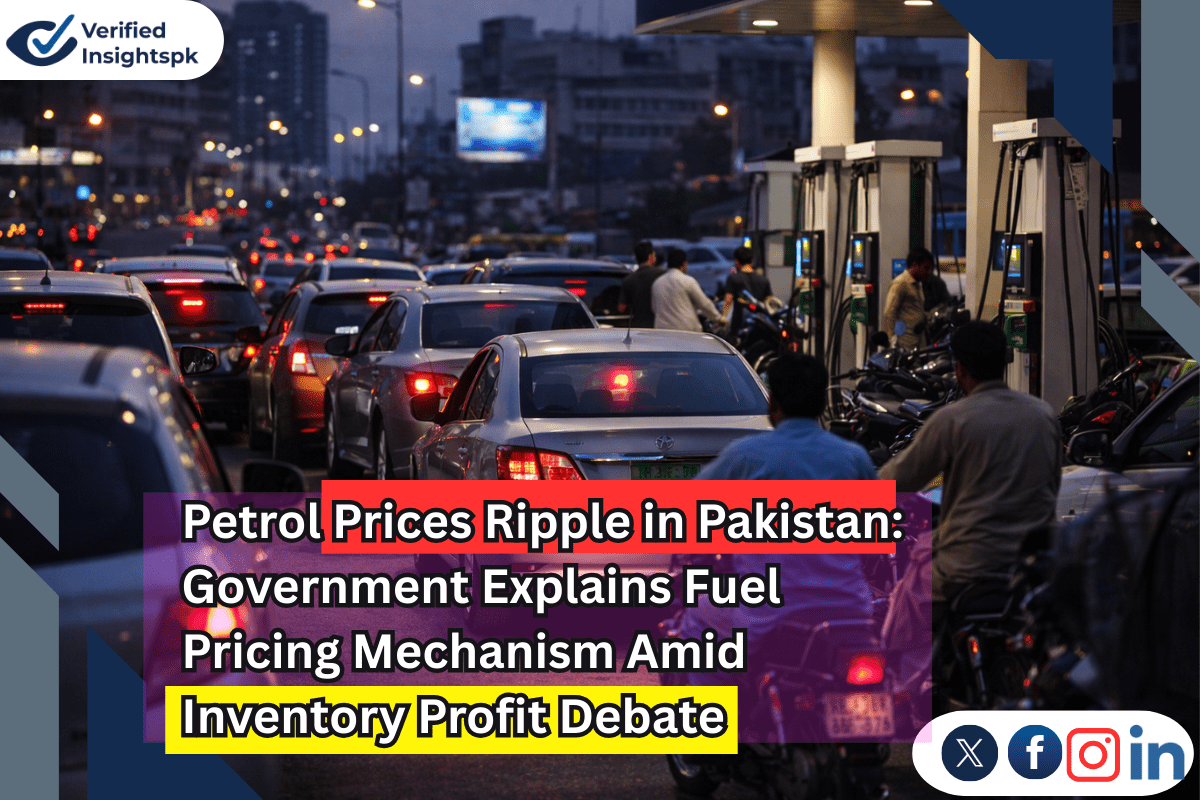
Petrol Prices Ripple in Pakistan: Government Explains Fuel Pricing Mechanism Amid Inventory Profit Debate
After a steep Rs55 per litre increase in petrol and diesel prices, officials say claims that oil companies are making huge “inventory profits” are based on a misunderstanding of the country’s fuel pricing system.
Pakistan’s Fuel Price Hike Sparks Debate Over Oil Company Profits
Pakistan’s recent decision to sharply increase petroleum prices has triggered widespread debate among consumers, economists, and policymakers.
The government raised petrol and diesel prices by Rs55 per litre, citing rising global oil costs driven largely by escalating geopolitical tensions in the Middle East, particularly the ongoing conflict involving the United States, Israel, and Iran.
However, the sudden increase has put additional pressure on households and businesses already struggling with inflation. At the same time, it has led to allegations that oil marketing companies (OMCs) may be earning large profits by selling fuel purchased earlier at lower prices.
However, government officials say these claims are misleading.
Also Read: Why Are Pakistan and Afghanistan Fighting? Inside the Escalation, Root Causes, and Future Scenarios
Government Rejects Claims of Massive Inventory Profits
Responding to growing criticism, Khurram Schehzad, an adviser to Pakistan’s finance ministry, clarified the country’s petroleum pricing system and rejected suggestions that oil companies are benefiting unfairly from the price hike.
According to Schehzad, the idea that companies are making large “inventory profits” comes from a misunderstanding of how petroleum prices are determined.
Moreover, he explained that fuel prices in Pakistan are calculated based on average international benchmark prices during a specific pricing period, rather than the cost of individual shipments purchased weeks earlier.
This benchmark pricing system is widely used in international energy markets.
Overall, under this mechanism, the government uses global Platts benchmark prices for petrol and diesel, combined with exchange rate adjustments, to determine local retail prices.
As a result, prices reflect the average global market conditions during the pricing period, not the cost of older fuel stocks.
Also read:OpenAI Faces Backlash After Pentagon AI Deal as ChatGPT Uninstalls Surge
Mandatory Fuel Stocks Complicate the Inventory Debate
Another key factor in Pakistan’s petroleum system is the requirement for oil companies to maintain a minimum supply of fuel at all times.
Under regulations set by the Oil and Gas Regulatory Authority (OGRA), oil marketing companies must maintain approximately 20 days of mandatory fuel stock.
This means companies must continuously replenish their supplies while simultaneously selling existing fuel.
In fact, in practical terms, every litre of petrol sold must eventually be replaced by a new litre purchased at current international prices.
Because of this requirement, Schehzad argues that any temporary gain from older inventory is quickly offset when companies must purchase new fuel at higher global prices.
In other words, the stock being sold is constantly being replaced with more expensive fuel.
Also Read:Iran War Live Updates: Israel Strikes Tehran and Beirut as Gulf Tensions Explode
Why Inventory “Profits” Are Often Temporary
The government adviser noted that inventory gains can sometimes appear during sudden price increases.
However, these gains often disappear when global oil prices fall.
In such situations, companies may be forced to sell fuel purchased at higher prices while retail prices are reduced due to international market declines.
However, this scenario can lead to substantial financial losses for refineries and oil marketing companies.
Example: Price Cuts in December
To illustrate this point, Schehzad referred to a situation last year when petrol prices in Pakistan were reduced significantly.
In December, domestic fuel prices dropped by approximately Rs24 per litre following a decline in international oil markets.
At that time, refineries and oil marketing companies were still holding mandatory inventory purchased at higher prices.
However, Because retail prices were lowered, these companies had to sell their higher-cost stock at the reduced government-regulated prices.
This resulted in billions of rupees in inventory losses.
Similar situations also occurred during 2022 and 2023, when multiple fuel price reductions forced companies to sell costly fuel inventories at lower prices.
Impact of Global Oil Markets on Pakistan
Pakistan’s fuel pricing is heavily influenced by global oil markets.
Because the country imports a large portion of its petroleum products, changes in international crude oil prices directly affect domestic fuel costs.
Moreover, the recent surge in prices is closely linked to rising global oil prices caused by geopolitical instability in the Middle East.
The ongoing regional conflict has disrupted supply routes and increased shipping costs, creating upward pressure on global energy markets.
For energy-importing countries like Pakistan, these developments can quickly translate into higher domestic fuel prices.
Economic Impact of Rising Fuel Prices
Higher petroleum prices have significant consequences for Pakistan’s economy.
Fuel costs directly affect several sectors, including:
- transportation
- agriculture
- manufacturing
- electricity generation
When petrol and diesel prices rise, transportation costs increase, which often leads to higher prices for goods and services across the economy.
This can worsen inflation and reduce purchasing power for households.
Even though, Businesses also face higher operational expenses, which may affect production costs and overall economic growth.
Government Balancing Act
Managing fuel prices is a complex challenge for the government.
On one hand, authorities must reflect international oil market trends in domestic prices to maintain supply stability.
On the other hand, sudden price increases can create public frustration and economic pressure.
However, the government, therefore, faces a delicate balancing act between:
- protecting consumers from high costs
- ensuring the financial sustainability of energy companies
- maintaining stable fuel supplies in the country
Why Transparency in Fuel Pricing Matters
The recent debate highlights the importance of transparency in Pakistan’s fuel pricing mechanism.
Misunderstandings about how petroleum prices are calculated can easily lead to public concern or speculation about unfair profits.
However, Experts say clearer communication about the pricing system may help improve public understanding of how global market changes affect domestic fuel costs.
As energy markets remain volatile due to geopolitical tensions, transparent policies will become even more important.
Conclusion
Finally, Pakistan’s latest fuel price increase has sparked intense public debate, particularly over whether oil companies are benefiting from inventory gains.
Government officials insist that such claims misunderstand how the petroleum pricing system works.
However, according to the finance ministry, prices are set using global benchmark averages, while mandatory inventory rules require companies to continuously replenish fuel at current market rates.
As global oil markets remain unstable due to geopolitical tensions, Pakistan is likely to continue facing fluctuations in fuel prices — making energy policy and pricing transparency key issues for both policymakers and consumers.
FAQ
Why did petrol prices increase in Pakistan?
Petrol prices were increased due to rising international oil prices influenced by geopolitical tensions in the Middle East.
Are oil companies making large inventory profits?
Well, Government officials say claims of massive profits are misleading because fuel prices are based on average global benchmarks rather than the cost of earlier shipments.
How are petrol prices calculated in Pakistan?
Prices are determined using international Platts benchmark averages along with exchange rate adjustments and regulatory costs.
What is the mandatory fuel stock rule?
Oil companies must maintain approximately 20 days of fuel reserves under regulations set by OGRA.
Can oil companies suffer losses due to price changes?
Yes. When international oil prices fall and domestic prices are reduced, companies may have to sell higher-cost inventory at lower regulated prices.