






Pakistan Strikes Kabul After Taliban Offensive: Escalation at Durand Line Raises Fears of Full-Scale Conflict
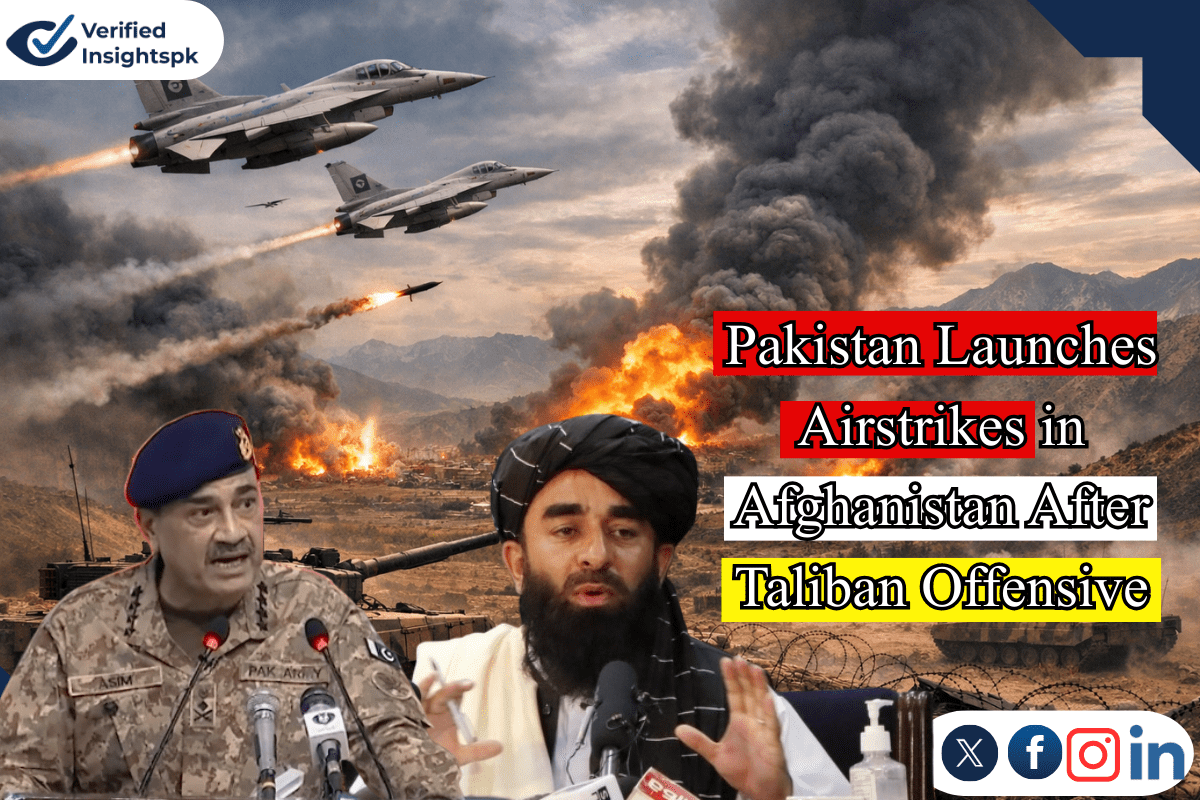
Pakistan carried out major airstrikes in Afghanistan on February 27, 2026, targeting locations in Kabul, Kandahar, and Paktika. The strikes came hours after the Afghan Taliban announced “large-scale offensive operations” against Pakistani military posts along the Durand Line, the disputed border between the two countries. Pakistani officials said the airstrikes were aimed at militant camps and security threats responsible for recent attacks inside Pakistan. According to Islamabad, the operation was a defensive response to protect national security and prevent cross-border terrorism.
However, Taliban authorities strongly rejected Pakistan’s claims. They stated that the strikes hit Afghan territory, including military positions and civilian-linked areas, and accused Pakistan of violating Afghanistan’s sovereignty. Both sides reported casualties and damage, although exact figures remain disputed. Pakistan’s defence leadership described the situation as reaching the level of “open war,” signaling a major escalation in tensions.
Meanwhile, global powers and international organizations, including the United Nations, China, Saudi Arabia, Iran, and Türkiye, urgently called for restraint and dialogue. The conflict has raised serious concerns about regional stability, cross-border security, and the risk of a wider military confrontation in South Asia.
Timeline of Events: How the Conflict Escalated
Understanding the current crisis requires looking at key events over the past several years. The tensions did not begin suddenly. Instead, they developed gradually after major political and military changes in Afghanistan.
August 2021:
The Afghan Taliban took control of Afghanistan after the withdrawal of US and NATO forces. This shift changed regional security dynamics. Pakistan initially hoped the new Afghan government would help control militant groups operating near the border.
2023–2025:
During this period, Pakistan repeatedly accused Afghan authorities of allowing the Tehreek-e-Taliban Pakistan (TTP) to operate from Afghan territory. Pakistan said these militants carried out suicide attacks, bombings, and assaults inside Pakistan. Taliban officials denied providing support and insisted Afghan soil was not used against other countries.
October 2025:
Heavy border clashes between Pakistani and Taliban forces killed dozens of soldiers and civilians on both sides. The situation became extremely dangerous. Qatar and Türkiye helped mediate a fragile ceasefire. Although fighting slowed, tensions remained unresolved.
February 22, 2026:
Pakistan launched targeted strikes inside Afghanistan, claiming it had hit militant camps and hideouts linked to cross-border terrorism. Afghan officials condemned the strikes and warned of consequences.
February 26, 2026:
The Afghan Taliban publicly announced plans for retaliation. Officials described Pakistan’s earlier strikes as violations of Afghan sovereignty and promised a military response.
February 27, 2026:
The Taliban launched offensive operations against Pakistani military positions along the Durand Line. In response, Pakistan carried out major airstrikes in Kabul, Kandahar, and Paktika. Artillery exchanges followed along multiple border sectors. Pakistani officials also reported intercepting drones targeting military areas, further escalating the confrontation.
This sequence of events shows how quickly long-standing tensions turned into one of the most serious military escalations between Pakistan and Afghanistan in recent years.
Also Read: Donald Trump Net Worth 2026, Age, Height, Health, and Latest News
Pakistan’s Military Response and Official Position
Pakistan responded decisively after the Taliban announced cross-border attacks near the Durand Line. The government stated that its strikes targeted militant hideouts responsible for terrorism inside Pakistan. Officials emphasized that the operation focused on terrorist sanctuaries, not civilians, highlighting Islamabad’s priority to safeguard national security.
The Afghan Taliban has been accused of providing safe havens to anti-Pakistan groups, including the Tehreek-i-Taliban Pakistan (TTP). Pakistan’s leadership stressed that such actions threaten the country’s sovereignty and cannot be tolerated. Information Minister Attaullah Tarar described the strikes as a response to “unprovoked aggression” and affirmed that Pakistan would continue protecting its borders against hostile forces.
Prime Minister Shehbaz Sharif praised the armed forces’ readiness, asserting that Pakistan can “crush any threats” against its territory. Meanwhile, Defence Minister Khawaja Asif warned that Pakistan’s patience had reached its limit, framing the confrontation as “open war” due to repeated provocations from Afghan soil.
Pakistan’s military advantages are significant. As a nuclear-armed state, it possesses a strong deterrent against conventional and unconventional threats. The Pakistan Air Force executed precise airstrikes targeting strategic locations in Kabul, Kandahar, and Paktika, demonstrating advanced strike capabilities. Combined with a modern conventional military, Pakistan’s forces hold superior operational capacity over the Taliban’s largely guerrilla-style units.
Through these operations, Pakistan aims to convert tactical military action into strategic leverage, sending a clear message: the country will not tolerate terrorist operations originating from across its borders. The coordinated response reinforces Pakistan’s sovereignty, deterrence posture, and regional security objectives, while signaling seriousness to both domestic and international audiences.
Also Read: Reddit Politics Explained |How Online Debate Shapes Modern Political Conversations|
Taliban Response and Afghan Government Position
The Afghan Taliban responded strongly to Pakistan’s airstrikes on Kabul, Kandahar, and Paktika. Officials described their operations as retaliation for strikes that targeted Afghan territory. The Taliban claimed to have destroyed multiple Pakistani border posts during cross-border operations.
Spokesperson Zabihullah Mujahid stated that Afghan forces were acting to defend national sovereignty. He emphasized that the Taliban would protect Afghan soil against any aggression while denying that they initiated the conflict. Mawlawi Wahidullah Mohammadi added that the operations were meant to uphold territorial integrity and respond to repeated violations of Afghan airspace.
The Taliban also accused Pakistan of violating Afghan sovereignty and claimed that civilian areas had been hit during strikes. Reports of casualties include women, children, and families in border provinces. While official numbers vary, the Taliban insist that Pakistani actions caused unnecessary suffering among Afghan civilians.
Former Afghan President Hamid Karzai weighed in on the conflict, calling on Pakistan to pursue good-neighbourly relations. He urged both sides to exercise restraint and prioritize the protection of civilians. Karzai stressed that the Afghan people would defend their homeland but cautioned that escalations could worsen humanitarian conditions.
This response highlights a stark contrast between Pakistan’s narrative of targeting militants and the Afghan perspective of defending territory. The situation underscores the complexity of cross-border hostilities, where military actions and civilian impacts fuel ongoing tensions. Analysts note that both narratives shape international perceptions and influence mediation efforts by Qatar, Saudi Arabia, Turkey, China, and other stakeholders.
Pakistan’s Military Operation and Strategic Objectives
Operation Ghazab lil-Haq: Purpose and Goals
Pakistan launched Operation Ghazab lil-Haq in response to repeated cross-border threats. The operation’s main objectives include:
- Destroying militant infrastructure across the Afghan border regions.
- Deterring Taliban military escalation along the Durand Line.
- Protecting Pakistani territory from terrorist incursions.
The operation is designed to neutralize immediate threats while sending a strong message about Pakistan’s commitment to border security.
Pakistan’s Military Doctrine
Pakistan’s response reflects its conventional warfare advantage. Key elements include:
- Air superiority: The Pakistan Air Force conducted precise strikes targeting strategic locations in Kabul, Kandahar, Paktika, and Nangarhar.
- Deterrence strategy: As a nuclear-armed state with advanced conventional forces, Pakistan projects strength to prevent further escalation.
- Operational coordination: Ground and air units work together to maximize effect against militant networks while minimizing civilian impact.
Battlefield Action vs Strategic Messaging
While the strikes target militant hideouts on the battlefield, Pakistan also communicates a strategic message:
- The country will not tolerate anti-Pakistan activities originating from Afghan soil.
- Military operations are coupled with diplomatic leverage, signaling seriousness to both domestic and international audiences.
- This dual approach reinforces Pakistan’s sovereignty, regional stability, and deterrence posture.
Operation Ghazab lil-Haq thus combines precision military action with strategic signaling. The operation aims to secure Pakistan’s borders, disrupt militant networks, and influence Taliban behavior without escalating into uncontrolled conflict.
Also read: Pakistan Raises Serious Terrorism Concerns at Tehran Regional Meeting on Afghanistan
Role of Tehreek-e-Taliban Pakistan (TTP) – Core Cause of Conflict
What is the TTP?
The Tehreek-e-Taliban Pakistan (TTP) is a militant group responsible for attacks inside Pakistan. It operates mainly along the Pakistan-Afghanistan border.
- Considered a terrorist organization by Pakistan and the international community.
- Responsible for suicide attacks, bombings, and targeted killings over the past decade.
- Aims to undermine Pakistani governance and spread extremist influence.
Pakistan’s Perspective
Pakistan holds the Afghan Taliban accountable for allowing TTP sanctuaries on Afghan soil. Key demands include:
- Elimination of militant safe havens used to stage attacks inside Pakistan.
- Verification mechanisms to ensure terrorists cannot operate across the border.
- Protection of Pakistani civilians and sovereignty.
UN monitoring reports have repeatedly documented TTP presence in Afghanistan, confirming links between the TTP and Taliban-aligned networks. These reports show that TTP fighters receive support, training, and shelter in Afghan provinces near the border.
Taliban Denial vs International Reports
The Afghan Taliban denies harbouring TTP militants or supporting cross-border attacks. However:
- Independent reports from the UN Security Council highlight ongoing TTP activity in Afghanistan.
- Analysts note a gap between Taliban statements and verified evidence of militant networks operating from Afghan territory.
Pakistan’s conflict with the Taliban, therefore, stems from the strategic challenge posed by TTP sanctuaries. Eliminating these safe havens is central to Pakistan’s military and diplomatic objectives, forming the core justification for operations like Ghazab lil-Haq.
Military Comparison: Pakistan vs Taliban Forces
Pakistan’s Military Strength
Pakistan holds a clear conventional advantage over the Afghan Taliban. Key capabilities include:
- Air Force: Advanced fighter jets and precision strike capability.
- Armored Units: Tanks and mechanized infantry for ground dominance.
- Missiles and Nuclear Weapons: Strategic deterrence and long-range strike capacity.
- Structured Army: Well-trained, professional, and coordinated forces capable of sustained operations.
Taliban’s Military Capabilities
The Afghan Taliban, in contrast, rely primarily on asymmetric tactics:
- Light Weapons: Rifles, mortars, and small arms dominate their arsenal.
- Guerrilla Warfare: Expert in hit-and-run attacks and border skirmishes.
- Limited Air Capability: No organized air force or advanced aerial platforms.
Why a Full War is Unlikely
Analysts argue that a conventional war between Pakistan and the Taliban is highly improbable:
- Taliban lack the resources, heavy weaponry, and air support to sustain open conflict.
- Pakistan’s superior firepower and structured military make confrontation costly and one-sided.
- Both sides may prefer controlled skirmishes and proxy operations, avoiding escalation into a prolonged war.
This military imbalance explains why Pakistan’s Operation Ghazab lil-Haq focuses on precision strikes, targeting militants while minimizing large-scale battlefield engagement.
International Reaction and Diplomatic Efforts
The escalation between Pakistan and Afghanistan has drawn widespread international concern. Global leaders are urging restraint and diplomacy to prevent further conflict.
United Nations
- The UN Secretary-General António Guterres called for immediate de-escalation.
- UN officials emphasized the protection of civilians under international law.
- Richard Bennett, UN Special Rapporteur for Afghanistan, highlighted the humanitarian impact and urged calm.
China
- China expressed deep concern over rising tensions along the Durand Line.
- Beijing called on both sides to resolve disputes through dialogue and negotiation.
- China has offered to mediate quietly, aiming to reduce hostilities and preserve regional stability.
Saudi Arabia, Iran, and Türkiye
- Saudi Arabia and Türkiye engaged in direct talks with Pakistan’s foreign minister, emphasizing the need for peace and coordination.
- Iran offered to mediate, focusing on humanitarian protection and border security.
Russia and India
- Russia expressed willingness to use diplomatic channels for de-escalation.
- India is closely monitoring the conflict, noting potential regional security risks.
Mediation Attempts
- Qatar and Türkiye previously facilitated a ceasefire in October 2025, which remains fragile.
- Current mediation focuses on reducing cross-border violence, reopening diplomatic channels, and managing refugee flows.
Global Concerns
- Regional instability: Escalation threatens broader South Asian security.
- Refugee crisis risk: Civilians fleeing conflict strain border communities and aid resources.
- Terrorism risk: Ongoing hostilities may allow groups like the TTP to exploit chaos.
International pressure underscores the importance of diplomatic engagement alongside military action. Experts note that long-term stability depends on both sides addressing the root causes of conflict and ensuring humanitarian protection.
Durand Line Dispute: Historical Background
Origins of the Durand Line
The Durand Line was drawn in 1893 between British India and Afghanistan. It was intended to define spheres of influence along the frontier.
- Negotiated by Sir Mortimer Durand for the British and Abdur Rahman Khan for Afghanistan.
- Meant to separate Afghan territory from British India while controlling the tribal regions.
Afghan Non-Recognition
- Afghanistan has never fully recognized the Durand Line as an official international border.
- This has fueled decades of tension with Pakistan after its creation in 1947.
Key Facts
- Length: Approximately 2,600 kilometers, stretching from Chitral in the north to Karachi in the south.
- Crosses mountains, valleys, and rivers, making enforcement and monitoring challenging.
Tribal and Ethnic Complexities
- The border divides the Pashtun and Baloch tribes, whose communities span both sides.
- These ethnic and tribal connections complicate security operations, governance, and cross-border trade.
- Historically, these areas have been militancy-prone due to weak state control and local allegiances.
The Durand Line remains a central point of contention in Pakistan-Afghanistan relations. Its historical ambiguity, tribal divisions, and strategic importance contribute to repeated cross-border conflicts, including the recent escalation and Operation Ghazab lil-Haq. Understanding this context is critical to analyzing ongoing tensions and regional security dynamics.
Economic and Regional Consequences
The recent escalation between Pakistan and Afghanistan is not only a security concern but also a serious economic issue.
Trade and Border Disruption
- Border closures have halted formal trade, affecting goods movement and commerce.
- Key crossings like Torkham and other border routes are partially or fully blocked.
- Refugees and displaced civilians further strain border management and humanitarian resources.
Impact on Pakistan and Afghanistan
- Pakistan: Trade slowdown affects local businesses, border economies, and transport networks.
- Afghanistan: Limited imports and exports disrupt markets, exacerbate economic hardship, and reduce revenue for local authorities.
Regional and Global Implications
- China’s Belt and Road Initiative (BRI): Infrastructure projects and trade corridors face delays and security risks.
- Regional trade routes: Transit corridors connecting Central Asia, South Asia, and Pakistan are under pressure, threatening cross-border investment.
- Regional instability: Prolonged conflict may discourage foreign investment and amplify economic uncertainty.
In summary, the conflict impacts not just bilateral relations, but also regional trade, investment projects, and broader economic stability. Addressing both security and economic concerns is critical for long-term stability in South and Central Asia.
Expert Analysis: Why This Escalation Is Different
The current Pakistan-Afghanistan confrontation represents a marked shift from previous border clashes. Analysts note that the scale and nature of the escalation are unprecedented in recent years.
Key Differences from Past Conflicts
- Deep strikes into Afghanistan: Pakistan’s air operations have targeted Kabul, Kandahar, and Paktika, extending well beyond border zones.
- Military over diplomacy: Diplomatic language has been replaced by bstan’s leadership, including declarations of “open war.”
- Public Taliban escalation: Afghan Taliban’s announcements of offensive actions are official, public, and widely disseminated, signaling a change from previous clandestine tactics.
Expert Warnings
Security analysts highlight several strategic risks associated with this escalation:
- Prolonged conflict: Continuous tit-for-tat strikes may spiral into sustained military confrontation, with no immediate resolution.
- Civilian casualties: Airstrikes and artillery fire near urban centers risk higher civilian casualties and displacement.
- Regional instability: Escalation threatens neighboring countries, trade routes, and cross-border economic projects, including Belt and Road corridors.
- Militant exploitation: Groups like the TTP could exploit the chaos to strengthen operational networks.
Strategic Implications
- Pakistan’s use of conventional superiority is designed to signal deterrence, but it also raises the stakes for diplomacy.
- Experts argue that unless both sides re-engage in structured dialogue and reduce public rhetoric, this escalation could entrench hostility and create a cycle of recurring conflict.
This escalation demonstrates that military action alone cannot resolve the underlying issues. Analysts stress the importance of parallel diplomatic efforts to manage risks and stabilize the region.
Possible Scenarios: What Happens Next
The Pakistan-Afghanistan escalation has created uncertainty. Experts outline several realistic scenarios based on military actions, diplomacy, and regional involvement.
1st Scenario: Diplomatic De-escalation
- Both sides agree to pause military operations and resume dialogue.
- Mediation by Qatar, Turkey, Saudi Arabia, and China could enforce a fragile ceasefire.
- Likelihood: Moderate, if both governments prioritize regional stability over domestic political pressure.
2nd Scenario: Continued Limited Military Strikes
- Pakistan and Taliban forces engage in targeted cross-border strikes without full-scale war.
- Civilian areas remain at risk, and border trade and movement continue to be disrupted.
- Likelihood: High, given entrenched positions and ongoing TTP threats.
3rd Scenario: Prolonged Proxy Conflict
- Escalation fuels proxy warfare, with militant groups acting independently or under external influence.
- Could last months or years, destabilizing border regions and exacerbating humanitarian crises.
- Likelihood: Low to Moderate, depending on Pakistan’s deterrence success and Taliban restraint.
4th Scenario: Regional Mediation Success
- Regional powers like China, Iran, Turkey, and Saudi Arabia broker a lasting framework for border security and counterterrorism cooperation.
- Potential to reopen borders, restore trade, and reduce civilian displacement.
- Likelihood: Moderate, but requires strong enforcement and compliance from both sides.
Strategic Takeaway
Experts emphasize that Pakistan’s military advantage may limit Taliban escalation, but structural and political solutions are essential for durable peace. The region remains highly vulnerable to instability, humanitarian crises, and disruption of trade corridors, making early diplomatic intervention critical.
Conclusion
The recent Pakistan-Afghanistan escalation underscores a complex mix of security, political, and regional dynamics.
- Root Cause: The conflict stems primarily from the presence of Tehreek-e-Taliban Pakistan (TTP) safe havens inside Afghanistan.
- Military Escalation: Pakistan’s strikes, including operations deep inside Kabul, Kandahar, and Paktika, represent a significant shift from previous border clashes.
- Taliban Response: Afghan forces have engaged in public, official military retaliation, signaling a new phase of confrontation.
- Civilian and Economic Impact: Border closures, trade disruption, and displacement of civilians highlight the humanitarian and economic toll of the conflict.
The Role of Diplomacy
- Despite the heightened military activity, diplomatic engagement remains critical.
- Regional mediators, including Qatar, Turkey, China, Saudi Arabia, and Iran, are key to reducing tensions and preventing long-term hostility.
Looking Ahead
- The future remains uncertain, with multiple possible scenarios, ranging from a ceasefire and negotiations to prolonged proxy conflicts.
- For lasting regional stability, Pakistan and Afghanistan must balance deterrence with dialogue, addressing both security concerns and structural solutions.
Strategic insight: Military might can control the battlefield, but diplomacy will ultimately shape the path toward peace or repeated escalation.
Disclaimer
The content in this article is based on publicly available information and verified reports as of February 27, 2026. While every effort has been made to ensure accuracy, verifiedinsightspk.com is not responsible for independent verification of claims or real-time developments. Opinions and analysis are those of the authors and experts cited. Readers should exercise caution and consult official sources for real-time updates.