







iPhone 18 Pro Price |Good News for Your Wallet Despite Memory Crisis|
Great news for iPhone fans planning to upgrade this year! Despite rising costs across the tech industry, Apple appears determined to keep the Apple iPhone 18 Pro and iPhone 18 Pro Max at the same prices as the current models.
What’s the Expected iPhone 18 Pro Price?
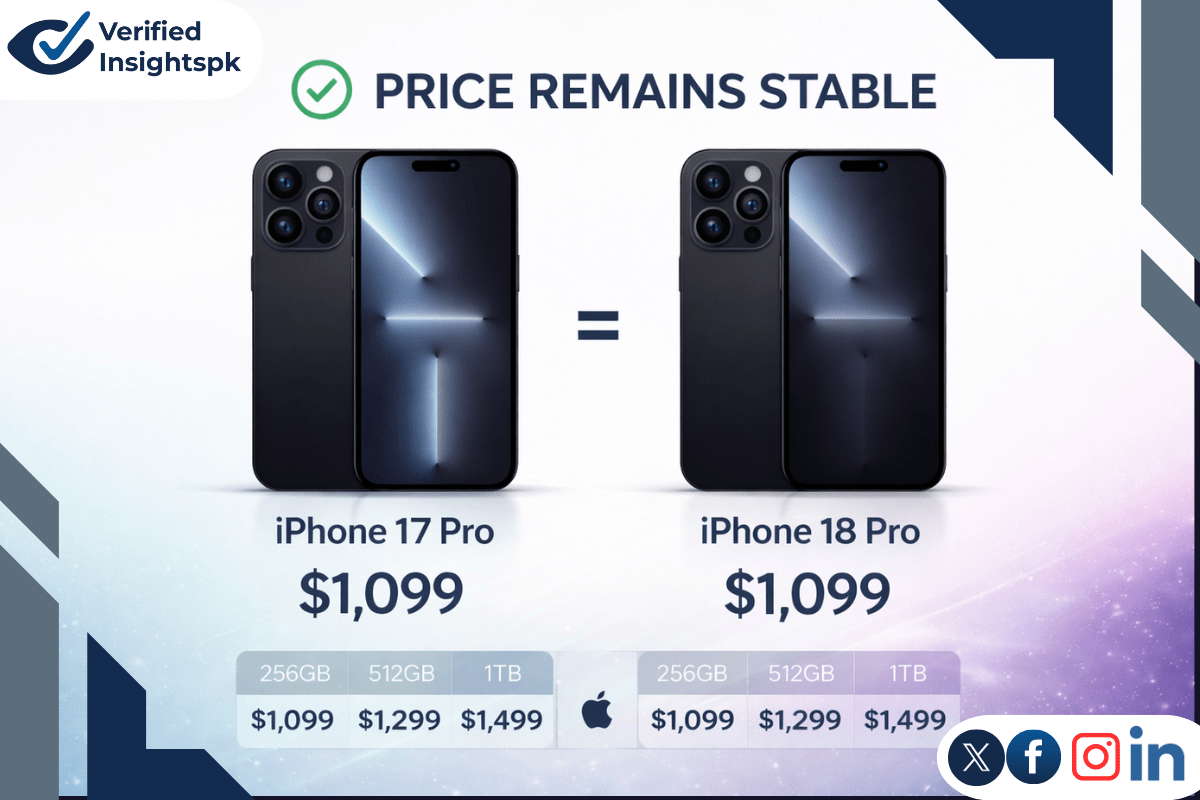
According to multiple industry analysts, Apple is working hard to maintain stable pricing for its upcoming flagship smartphones. In the U.S., the iPhone 17 Pro starts at $1,099, and the iPhone 17 Pro Max starts at $1,199, and the iPhone 18 models are expected to match these prices when they launch in September 2026.
This is surprisingly good news, especially considering the challenges Apple faces with rising component costs.
The Memory Price Crisis Explained
The tech world is experiencing what some call a “RAM crisis.” Here’s what’s happening in simple terms:
AI is Eating Up Memory Supply. The explosive growth of artificial intelligence has created a massive demand for memory chips. Companies building AI servers are buying up DRAM and NAND storage chips at unprecedented rates, causing prices to skyrocket.
How Bad Is It? By the end of this year, the price of DRAM will quadruple from 2023 levels, and NAND will more than triple, estimates TechInsights. That’s a huge jump in just three years!
Mike Howard, an analyst for research firm TechInsights, estimates that Apple could pay $57 more for the two types of memory that go into the base-model iPhone 18 due this fall compared with the base model iPhone 17.
For a company making millions of iPhones, that $57 per phone adds up to billions of dollars in extra costs.
How Apple Plans to Keep Prices Steady
So how is Apple managing to avoid passing these huge cost increases to customers? The company has several smart strategies in play. Let’s see how the iPhone 18 Pro Price will be steady.
1. Negotiating Better Deals with Suppliers
Jeff Pu, an equity analyst with investment firm GF Securities, believes that Apple has been negotiating with Samsung and SK Hynix to achieve relatively “favourable” memory chip deals, amid skyrocketing prices for DRAM and NAND storage.
Apple’s massive buying power gives it leverage that smaller companies don’t have. When you’re ordering memory chips for hundreds of millions of phones, suppliers are willing to offer better terms.
2. Cutting Costs in Other Areas
Pu also expects Apple to find ways to lower the costs of some other core iPhone components, including the display and cameras.
This doesn’t necessarily mean worse quality. Apple may negotiate better prices from display manufacturers, use more efficient production methods, or make subtle design changes that reduce costs without affecting performance.
3. Long-Term Supply Contracts
Kuo says that Apple negotiates memory prices with suppliers every quarter, giving the company more flexibility to adapt to market changes than competitors who lock in prices for longer periods.
Kuo says that Apple has a plan for dealing with higher component prices, even if it reduces the tech giant’s gross margins. The plan is for Apple to buy the chips, eat the additional expense of paying the higher costs, and, by not raising prices, gain market share.
What Tim Cook Says About the Situation
Apple CEO Tim Cook addressed these cost pressures during the company’s recent earnings call.
Cook said that rising memory chip prices had a “minimal impact” on Apple’s gross margin in the fourth quarter of the 2025 calendar year, but he does expect a “bit more of an impact” on the company’s gross margin in the current quarter.
Cook added that Apple is aware of the rising prices and “will look at a range of options to deal with that” over the long term, if necessary.
The good news? Speaking to analysts on January 29, Tim Cook confirmed that RAM and flash memory pricing haven’t yet affected Apple, but that it will become a problem later in the year.
This means Apple has some breathing room to figure out solutions before the iPhone 18 launches in fall 2026.
Two Top Analysts Agree on Pricing
It’s not just one analyst making these predictions. Two of the most respected Apple watchers in the industry are saying the same thing.
Jeff Pu (GF Securities): Pu said his firm’s recent “supply chain research” indicates that Apple is focused on “cost management,” in an attempt to keep the starting prices of the iPhone 18 Pro models either “unchanged” or at a “similar level” compared to the iPhone 17 Pro models.
Ming-Chi Kuo (Industry Veteran): Ming-Chi Kuo also said that Apple’s plan for the iPhone 18 Pro models was to “avoid raising prices as much as possible.” He predicted that Apple would at least keep starting prices “flat” compared to the iPhone 17 Pro models.
When two independent analysts with different sources reach the same conclusion, it’s usually a reliable prediction.
Why This Matters for Buyers
Keeping prices stable is huge for several reasons:
- No Sticker Shock: You won’t need to adjust your budget if you’re planning to upgrade. The iPhone 18 Pro will cost the same $1,099 as the current model.
- Better Value Than Competitors: If Apple can keep prices the same, it could help provide an advantage if competitors decide they have to make their own pricing adjustments.
If Samsung, Google, and other manufacturers raise their flagship phone prices while Apple holds steady, the iPhone becomes relatively more affordable.
- Market Share Strategy Apple is willing to accept lower profit margins on each phone sold to maintain or grow its market share. This benefits consumers directly.
The Services Strategy
Here’s an interesting part of Apple’s plan: the company can afford to make less money on hardware because its Services business is booming.
That Apple is willing to keep prices flat while some components cost more and others are in short supply tells us much about Apple’s Services business, which is the company’s second-largest business segment after the iPhone. Services revenue jumped 13.93% during the fiscal first quarter of 2026 year-over-year to $30.01 billion.
Apple makes money from:
- App Store purchases
- Apple Music subscriptions
- iCloud storage
- Apple TV+
- AppleCare
- Apple Pay transactions
Once someone buys an iPhone, they often subscribe to multiple Apple services for years. This recurring revenue allows Apple to be more flexible with iPhone pricing. That could also be the reason behind the iPhone 18 Pro price dropping in the future.
Current iPhone 17 Pro Pricing
To understand what to expect for the iPhone 18, here’s what the current models cost:
iPhone 17 Pro:
- 256GB: $1,099
- 512GB: $1,299
- 1TB: $1,499
iPhone 17 Pro Max:
- 256GB: $1,199
- 512GB: $1,399
- 1TB: $1,599
- 2TB: $1,999
The iPhone 18 Pro models are expected to follow this same pricing structure.
When Will iPhone 18 Launch?
Apple is expected to unveil the iPhone 18 Pro models in September, following the company’s traditional fall launch schedule.
However, there’s an interesting twist this year. The iPhone 18 won’t be introduced until the first quarter of 2027, along with the iPhone 18e and the iPhone Air 2.
This means Apple will launch the Pro models first in September 2026, then release the standard iPhone 18 and budget iPhone 18e several months later in early 2027.
What About the New Features?
While prices may stay the same, you’ll still get meaningful upgrades with the iPhone 18 Pro:
Expected Improvements:
- New A20 Pro chip with 2nm technology (more powerful and efficient)
- Improved camera system with better low-light performance
- Enhanced AI capabilities
- Better battery life
- Refined design
The challenge for Apple is delivering these improvements while keeping costs under control.
The Bigger Picture
The rising cost of memory is Apple’s (and others) biggest problem in 2026, but Apple appears better positioned than most companies to handle it.
Maintaining a static price point of $1,099 for the iPhone 18 Pro model and $1,199 for the Pro Max requires more than just clever negotiation. Analysts suggest that Apple is looking at every stage of the manufacturing process to find savings.
Should You Wait for iPhone 18?
If you’re currently using an older iPhone and planning to upgrade, the stable pricing makes the iPhone 18 Pro an attractive option. You’ll get the latest technology without paying extra compared to today’s models.
However, if you just bought an iPhone 17 Pro, the incremental improvements probably won’t justify upgrading just one year later.
What Happens After 2026?
The real question is how long Apple can maintain this pricing strategy. Speaking to analysts on January 29, Tim Cook confirmed that RAM and flash memory pricing haven’t yet affected Apple, but that it will become a problem later in the year.
If memory prices continue rising through 2027 and beyond, Apple may eventually need to adjust iPhone prices. But for the iPhone 18 launching in September 2026, the outlook is positive.
The Bottom Line
Despite facing one of the biggest cost challenges in years, Apple is committed to keeping iPhone 18 Pro price and iPhone 18 Pro Max prices unchanged at $1,099 and $1,199, respectively.
The company is using its market power, smart negotiations, cost-cutting in other areas, and strong Services revenue to absorb the higher component costs rather than passing them to customers.
For iPhone buyers, this is genuinely good news. You’ll be able to get the latest and greatest iPhone technology without paying more than you would today.