





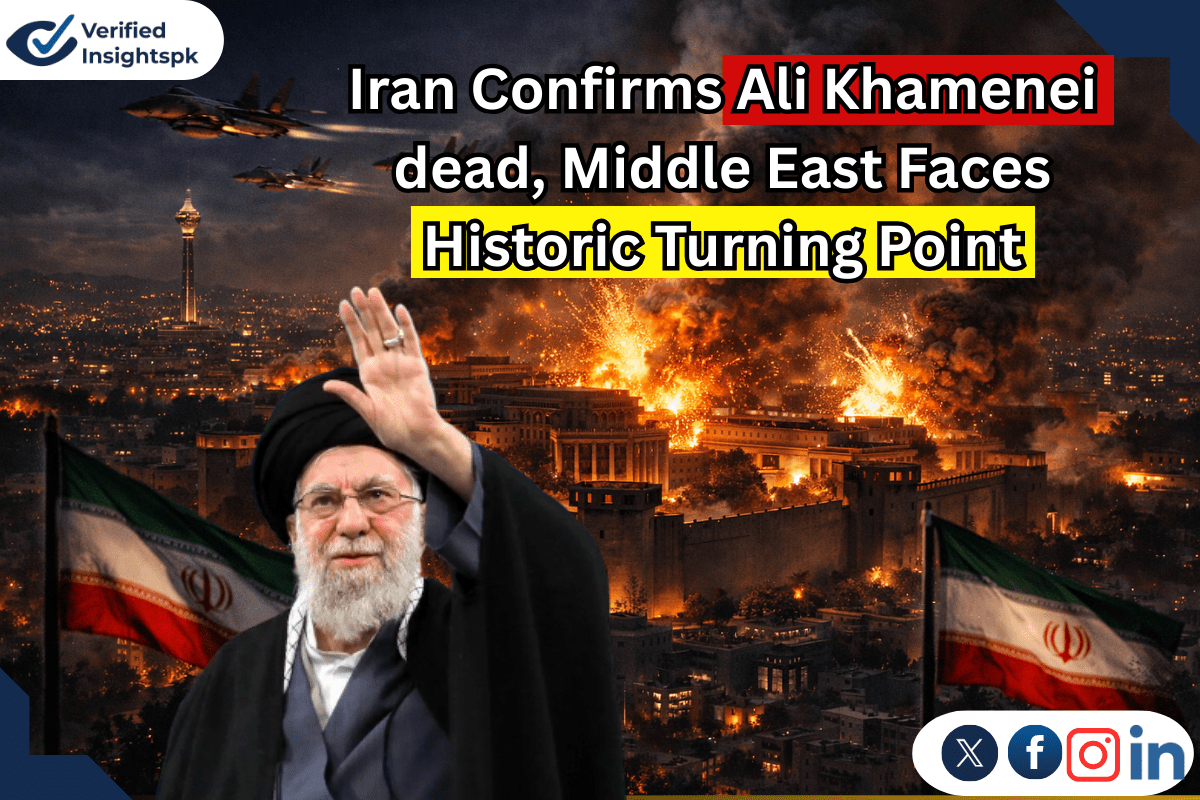
Ali Khamenei Reportedly Killed in US-Israel Strikes: Iran Confirms Ali Khamenei dead, Middle East Faces Historic Turning Point
Iranian state television has confirmed that Ali Khamenei dead following major airstrikes reportedly carried out by the United States and Israel. The announcement marks one of the most significant political developments in modern Middle East history.
According to Iranian officials, Khamenei died after precision strikes targeted high-security military and leadership locations. Authorities immediately declared 40 days of national mourning, reflecting the scale of the national loss.
This moment represents the end of Khamenei’s 36-year rule, which began in 1989. During his leadership, he held ultimate authority over Iran’s military, nuclear policy, and foreign relations.
Government officials described the situation as a national emergency, while military forces moved to maximum alert. Security presence increased across major cities, including Tehran, Mashhad, and Isfahan, after Ali Khamenei dead.
Meanwhile, global leaders began urgent diplomatic consultations. The international community fears the crisis could trigger a wider regional conflict.
Also Read: Trump’s State of the Union 2026: Key Announcements, Iran Tensions, Tariffs, and Political Divisions
How the Airstrikes Happened
Targeted Military and Leadership Locations
Initial reports indicate that the strikes targeted strategic military compounds and command centers. These locations included facilities believed to house senior leadership and defense infrastructure.
Explosions were reported across multiple secure zones. Witnesses described loud blasts, fire, and emergency vehicle movements throughout the night.
Military analysts believe the operation aimed to disrupt Iran’s command structure. Precision-guided weapons reportedly struck specific high-value targets.
The strikes appeared highly coordinated. This suggests extensive intelligence planning before execution.
US and Israel Strategic Role
Statements from US and Israeli officials described the operation as necessary for regional security. Officials claimed the targets were linked to military threats and strategic planning.
Washington emphasized protecting allies and deterring future attacks. Israeli officials described the strikes as defensive action against long-term threats.
However, Iranian authorities condemned the attack as an act of war. Officials warned of severe consequences and promised retaliation.
The operation has dramatically increased military tension across the Middle East.
Iran’s Immediate Military Response After Ali Khamenei dead
Iran responded quickly. Missile launches and drone deployments were reported across several regions.
Military bases and strategic installations moved into emergency defense mode. Air defense systems were activated across major cities.
Iranian military leaders promised decisive retaliation. Officials emphasized that Iran would defend its sovereignty.
Security forces strengthened protection around nuclear and military facilities. Airports and key infrastructure also increased security measures.
Regional countries immediately raised military readiness levels. Airspace monitoring intensified across the Gulf region.
The risk of further escalation remains extremely high.
Who Was Ali Khamenei
Rise to Power After the Islamic Revolution
Ali Khamenei became Iran’s Supreme Leader in 1989. He succeeded Ruhollah Khomeini, the leader of the 1979 Islamic Revolution.
Before becoming Supreme Leader, Khamenei served as Iran’s president. He built strong influence within the political and military establishment.
His leadership shaped Iran’s modern political identity. He guided the country through sanctions, wars, and diplomatic confrontations.
His authority lasted longer than most global leaders.
Absolute Authority Over Military and Nuclear Policy
As Supreme Leader, Khamenei controlled Iran’s armed forces. He also had final authority over nuclear decisions.
He appointed senior military commanders and judiciary leaders. His approval was required for major national policies.
His influence extended beyond politics. He shaped Iran’s ideological and strategic direction.
Because of this authority, his death creates a major power vacuum.
Leadership Crisis: Who Will Control Iran Now
Iran’s constitution requires the Assembly of Experts to appoint a new Supreme Leader. This clerical body holds the legal authority to select the successor.
However, leadership transitions can create instability. Power struggles between political factions remain possible.
Military leaders may also influence the process. The Islamic Revolutionary Guard Corps holds significant power.
Possible immediate outcomes include:
- Rapid appointment of a successor
- Temporary leadership council
- Internal political competition
- Increased public protests
Each scenario carries major risks.
Leadership uncertainty often increases national instability.
Also Read: Trump’s Gaza Peace Plan 2025: Real Hope or Political Mirage?
Regional Military Tension Reaches Critical Levels
The strikes and leadership loss have dramatically increased regional tension.
Several countries raised military alert levels. Air defenses were activated across multiple Middle Eastern capitals.
Naval forces increased patrols in the Persian Gulf. Military aircraft began surveillance missions.
Oil markets reacted immediately. Energy prices rose due to supply fears.
Commercial airlines adjusted routes. Some flights avoided high-risk airspace.
The region now faces one of its most dangerous moments in decades.
Global Reaction: World Leaders Express Concern
Global leaders quickly responded to the crisis.
The United Nations called for restraint. Officials warned against escalation.
China and Russia urged diplomatic solutions. Both countries emphasized regional stability.
European leaders expressed deep concern. They urged all sides to avoid war.
Gulf countries increased military readiness. Neighboring states fear direct impact.
International markets showed volatility. Investors reacted to uncertainty and conflict risk.
Diplomatic channels remain active. However, tensions continue rising.
Impact on Global Energy and Economy
Iran plays a major role in global energy supply. Any instability affects oil markets.
Energy prices increased immediately after the news. Traders fear supply disruptions.
Shipping routes near the Persian Gulf face potential risk. Military conflict could disrupt trade.
Global markets reacted with caution. Stock markets showed volatility.
Energy-dependent economies may face inflation pressure.
Economic uncertainty could continue for months.
Military Balance and Strategic Risk
Iran maintains a large military force. Its missile and drone programs remain advanced.
However, prolonged conflict would create serious consequences. Infrastructure damage could weaken military capability.
Military analysts warn about escalation risk. Regional war could involve multiple countries.
Strategic alliances may shift rapidly. Global powers could influence outcomes.
Military deterrence remains critical to preventing full war.
However, tensions remain extremely fragile.
Risk of Wider Middle East War
Experts warn this crisis could expand beyond Iran.
Possible escalation scenarios include:
- Missile exchanges between regional powers
- Attacks on military bases
- Naval confrontation in the Gulf
- Proxy conflicts in neighboring countries
Each development increases global security risk.
Diplomatic intervention remains essential.
Without negotiation, escalation becomes more likely.
Historical Significance of This Moment
This event marks the end of one of the longest leadership periods in modern history.
Khamenei influenced Iran’s political, military, and ideological direction for decades.
His leadership defined Iran’s relationship with Western powers.
His death changes the region’s strategic balance.
Future leadership decisions will shape Iran’s direction.
This moment may redefine Middle East geopolitics.
What Happens Next: Possible Scenarios
Experts outline several realistic outcomes after Ali Khamenei’s death:
Scenario 1: Controlled Leadership Transition
Iran quickly appoints a new Supreme Leader. This stabilizes internal politics.
Scenario 2: Limited Military Retaliation
Iran launches controlled retaliation while avoiding full war.
Scenario 3: Prolonged Regional Tension
Conflict continues through indirect military actions.
Scenario 4: Diplomatic De-escalation
International mediation reduces tension.
Each scenario remains possible.
Future developments will determine regional stability.
Is This A turning Point?
The reported Ali Khamenei dead represents a historic turning point. His leadership shaped Iran for more than three decades.
The airstrikes have dramatically increased regional tension. Military readiness remains high across the Middle East.
Iran now faces a major leadership transition. Political stability depends on how quickly a successor emerges.
Global powers continue urgent diplomatic efforts. Preventing wider conflict remains the highest priority.
However, uncertainty remains extremely high.
The coming weeks will determine whether the region moves toward war or stability.
This moment may reshape Middle East politics for decades.
FAQ
Who was Ali Khamenei?
Ali Khamenei was Iran’s Supreme Leader from 1989 until his reported death in 2026.
How did Ali Khamenei reportedly die?
Reports claim he died after US-Israel airstrikes targeted Iranian military and leadership locations.
Who will replace Iran’s Supreme Leader?
Iran’s Assembly of Experts will select the next Supreme Leader.
Could this trigger a war?
Experts warn escalation risk exists, but diplomatic efforts continue.
Who was the president of Iran who just died?
The most recent Iranian president who died before the current crisis was Ebrahim Raisi, who died in a helicopter crash on 19 May 2024. After his death, early elections were held, and Masoud Pezeshkian was elected and took office on 28 July 2024.
Is Ali Khamenei still in power?
No. Ali Khamenei was killed in February 2026 during joint US–Israeli airstrikes on Iran, ending his nearly four decades as Supreme Leader.
Who is the new president of Iran?
Iran’s president since July 2024 is Masoud Pezeshkian. He remains in office following the 2024 election and is currently serving as president. Additionally, after Khamenei’s death, an interim leadership council, including Pezeshkian, is temporarily handling some state duties until the Assembly of Experts chooses a new Supreme Leader.
What happened to Imam Khomeini?
Ruhollah Khomeini, the leader of the 1979 Islamic Revolution, served as Iran’s first Supreme Leader. He died of natural causes on 3 June 1989 at the age of 89. After his death, Khamenei was appointed his successor as Supreme Leader.
Disclaimer
This article is based on emerging reports, official statements, and international media coverage available at the time of publication. Information may evolve as governments release verified confirmations. VerifiedInsightsPK does not claim independent confirmation of classified military operations.