





Historic US-Iran Peace Talks Begin in Islamabad: Everything That Happened on April 11, 2026
For the first time since the 1979 Islamic Revolution, the United States and Iran sat face to face to negotiate peace. They chose Islamabad. They chose Pakistan.
The Day History Was Made in Islamabad
Saturday, April 11, 2026, will be remembered as one of the most significant days in Pakistan’s diplomatic history.
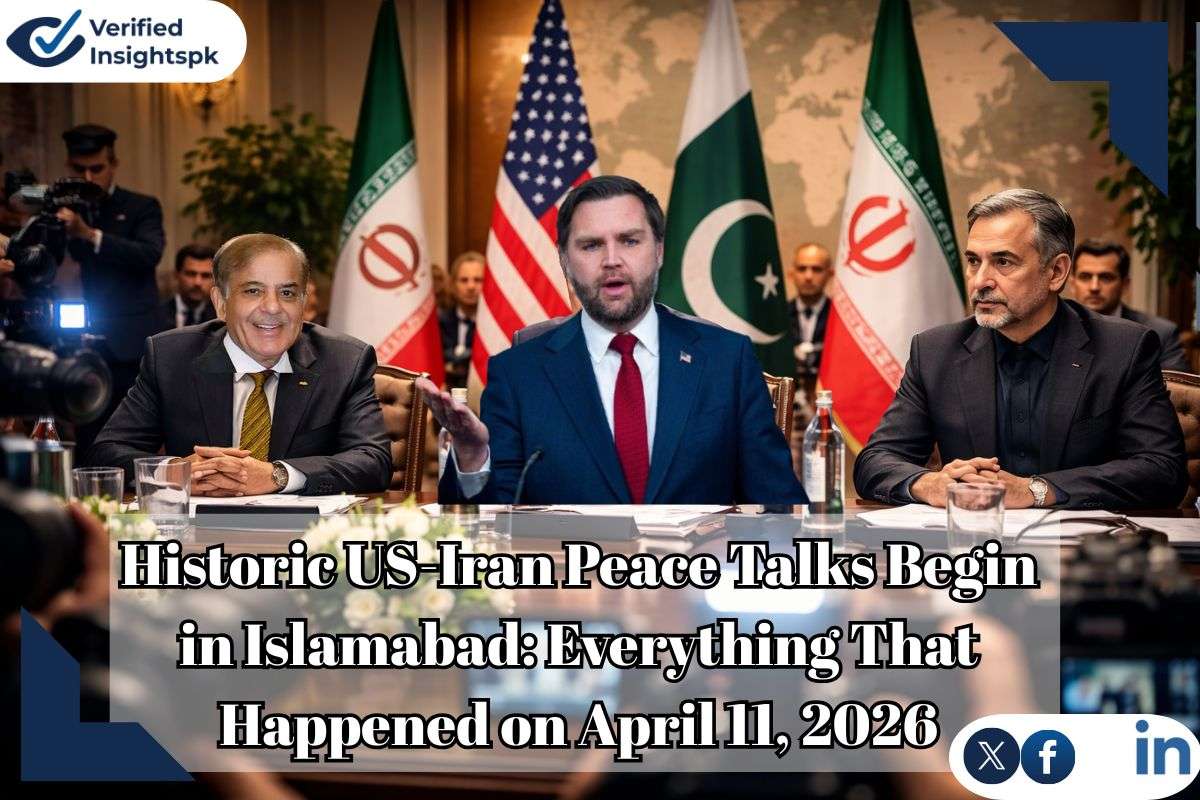
Top officials from the United States and Iran met directly in Islamabad for ceasefire talks. These are the highest-level face-to-face negotiations between the two countries since the Islamic Republic was founded in 1979. That is 47 years without direct talks, until today.
The talks are taking place against the backdrop of a six-week war between the US, Israel, and Iran. A fragile two-week ceasefire was announced on April 7. Pakistan brokered that ceasefire. Now, Pakistan is hosting the peace talks aimed at making that ceasefire permanent.
The world is watching Islamabad today.
Who Is Sitting at the Table?
Both delegations arrived at Nur Khan Air Base in Islamabad. They were received by Field Marshal Asim Munir, Deputy Prime Minister Ishaq Dar, and Interior Minister Mohsin Naqvi.
The American delegation is led by US Vice President JD Vance. He is joined by special envoy Steve Witkoff and Jared Kushner, President Trump’s son-in-law. It is a powerful team. Vance is the second most senior official in the United States government.
The Iranian delegation is led by parliamentary speaker Mohammad Bagher Ghalibaf and Foreign Minister Abbas Araghchi. Iran sent a total of 71 people. The delegation named itself “Minab 168” — after the 168 schoolchildren and teachers killed in a US strike on a primary school in Minab on the first day of the war. The name carries deep symbolism. It tells you that Iran is not coming to these talks lightly.
Both delegations first met separately with Prime Minister Shehbaz Sharif. Then they came together for direct talks in the afternoon.
How the Talks Actually Started
The original plan was for “proximate talks.” That means each side would sit in separate rooms and Pakistan would carry messages between them.
But something changed.
Al Jazeera’s reporter in Islamabad confirmed that sources close to the mediation said both teams moved into direct face-to-face negotiations, with Pakistani mediators also present in the room. That is a significant upgrade from what was planned.
It is also the first time the two countries have spoken directly since 1979.
The first phase of talks has now concluded, according to Al Jazeera sources. Both sides are now exchanging written texts to confirm they are on the same page on the agreements reached in the first round.
What Each Side Wants
Understanding the talks requires understanding what each side is demanding.
The United States wants:
The Strait of Hormuz has fully reopened for international shipping. No nuclear weapons for Iran. Limits on Iran’s military capabilities. President Trump told reporters, “No nuclear weapon. That’s 99% of it.”
Iran wants:
Full sovereignty over the Strait of Hormuz. Complete removal of US sanctions. Release of all frozen Iranian assets. War reparations for damage caused by US and Israeli strikes. A ceasefire that covers Lebanon, not just Iran. Iran has presented four demands it calls “non-negotiable” — full control of the Strait, war reparations, unconditional release of frozen assets, and a durable ceasefire across the entire West Asia region.
The gap between the two sides is large. But the fact that they are talking directly is already progress.
Also Read: Why Are Pakistan and Afghanistan Fighting? Inside the Escalation, Root Causes, and Future Scenarios
Iran’s Trust Problem — And Why It Matters
Iran arrived in Islamabad with something unusual. It arrived with hope but without trust.
Ghalibaf said it plainly when he landed: “We have goodwill, but we do not trust.”
He added that Iran’s experience of negotiating with America has “always ended in failure and violations of commitments.” That is a reference to the 2015 nuclear deal, which the US later withdrew from under Trump’s first term.
Iran’s First Vice President Mohammad Reza Aref said the outcome of these talks depends entirely on whether the US focuses on its own “America First” interests or on “Israel First” interests. In other words, Iran is watching closely whether the US will pressure Israel to stop strikes on Lebanon.
That is the central tension in these talks.
Also Read: IHC Orders Imran Khan’s Meeting With Lawyer as Al-Qadir Trust Case Hearing Delayed Again
The Lebanon Problem That Could Break Everything
The biggest obstacle to a deal is Lebanon.
When the ceasefire was announced on April 7, Pakistan’s Prime Minister Shehbaz Sharif said it covered “everywhere, including Lebanon.” Iran says Lebanon must be included. Pakistan says Lebanon must be included.
But Israel says Lebanon is not part of the ceasefire. Israeli military operations in Lebanon are continuing. More than 2,000 people have been killed in Lebanon since March, according to Lebanon’s health ministry. At least 10 more were killed on Saturday alone.
Ghalibaf issued a clear warning before talks began. He said negotiations cannot start unless Israel halts its attacks in Lebanon and unless the US releases Iran’s frozen assets. Despite that warning, the talks still went ahead.
Al Jazeera’s reporter in Islamabad said there are reports of a possible understanding to limit Israeli strikes to southern Lebanon only. That is not a full ceasefire. But it may be enough to keep talks moving forward.
The US has reportedly asked Israel to pause strikes on Hezbollah to avoid derailing the negotiations. The ceasefire expires on April 21. That gives everyone less than 10 days to reach a framework agreement.
The Strait of Hormuz: Still Largely Closed
One of the clearest signs that the war is not truly over is the Strait of Hormuz.
The Strait connects the Persian Gulf to the open ocean. About 20% of the world’s oil and gas passes through it every day. Iran effectively blocked it when the war began. That blockade has caused the biggest disruption to global energy supplies in history.
The two-week ceasefire required Iran to reopen the Strait. But that has not fully happened.
Only a handful of ships have passed through on Saturday. A few Chinese tankers and bulk carriers made it through. Some were sailing close to the Iranian coastline. But normal traffic is around 100 ships per day. Saturday’s movement is a tiny fraction of that.
Iran says it will only allow passage through the Strait under its own controlled conditions. The US says it is “clearing out the Strait of Hormuz” as a favour to the world.
Trump posted on Truth Social: “We’re now starting the process of clearing out the Strait of Hormuz as a favor to Countries all over the World, including China, Japan, South Korea, France, Germany, and many others.”
Until the Strait fully reopens, global oil prices remain under pressure. Pakistani fuel prices are directly affected.
Pakistan’s Role: Historic and High Stakes
Pakistan did not stumble into this role. It earned it.
Rasheed Wali Janjua, director of research at the Islamabad Policy Research Institute, said it clearly: Pakistan’s standing as a trusted mediator is “a very rare concurrence, because no other country enjoyed the same kind of trust from both parties.”
President Trump named PM Shehbaz Sharif and Field Marshal Asim Munir personally in his ceasefire announcement. Iran’s foreign minister thanked them by name, too. That double acknowledgement from both sides is extraordinary.
Pakistan’s position is unique. It has warm ties with both Washington and Tehran. Moreover, Pakistan shares a 900-kilometre border with Iran. It is home to the world’s second-largest Shia Muslim population. Pakistan represents some Iranian interests in Washington, where Iran has no embassy. It also has a strong relationship with the Trump administration.
Ishtiaq Ahmad, professor emeritus at Quaid-i-Azam University, said that if the talks succeed, it could lead to “radically changed perceptions of Pakistan” in the world.
Islamabad declared a two-day public holiday. Nur Khan Air Base handled both delegations. Serena Hotel is surrounded by security. Army helicopters fly over the Red Zone. Pakistan is taking this moment seriously.
What Trump Is Saying Right Now
Trump is not in Islamabad. He is at his Virginia golf club. But he is watching closely and posting.
He said Iran “has no cards” in these negotiations. Donald Trump described Iran’s blockade of the Strait as “a short-term extortion of the world.” He warned that US warships are being reloaded with weapons in case talks fail.
At the same time, he acknowledged progress. He said the Strait will reopen “fairly soon” with or without Iran’s cooperation.
Trump’s tone mixes pressure with optimism. That is typical of his negotiating style. The question is whether it works with Iranian negotiators who arrived saying they do not trust the US.
What Happens Next
The first round of direct talks has concluded. Both sides are now comparing written texts.
The ceasefire expires on April 21. That is 10 days away. There is no room for extended delays. Both sides need to either agree on a framework or the ceasefire collapses and the war resumes.
Pakistan is pushing for a deal. PM Sharif’s office said these talks should serve as “a stepping stone toward durable peace in the region.”
The key issues still unresolved are: the Lebanon ceasefire, Iran’s frozen assets, the Strait of Hormuz, and the nuclear question.
None of these is easy. But today marks the first real attempt to resolve them face-to-face.
Verified Insights Pakistan’s View
Today is genuinely historic. Two countries that have not spoken directly in 47 years sat together in Islamabad. Pakistan made that happen.
This is not just a diplomatic win for the government. It is a national moment. Pakistan is at the centre of one of the most consequential negotiations the world has seen in years.
The risks are real. The gaps between the US and Iran are large. The Lebanon question could collapse everything. Iran does not trust America. Trump’s patience has limits.
But Pakistan is in the room. Field Marshal Munir walked JD Vance off the plane himself. PM Sharif met both delegations before they met each other. That kind of personal involvement is what makes this work.
If these talks produce a framework, even a partial one, Pakistan will have changed its image in the world permanently. From a country defined by crises to a country that helps resolve them.
That matters for every Pakistani.
Quick Facts: Islamabad Talks at a Glance
| Detail | Information |
| Date | Saturday, April 11, 2026 |
| Location | Islamabad, Pakistan (Serena Hotel) |
| US Delegation Lead | Vice President JD Vance |
| US Team Includes | Steve Witkoff, Jared Kushner |
| Iran Delegation Lead | Speaker Ghalibaf, FM Araghchi |
| Iran Delegation Size | 71 people |
| Pakistan Host | PM Shehbaz Sharif, FM Ishaq Dar, Field Marshal Asim Munir |
| Talk Format | Direct (face-to-face), Pakistan mediating |
| Historical Significance | First direct US-Iran talks since 1979 |
| Ceasefire Expiry | April 21, 2026 |
| Status | First phase concluded, texts being exchanged |
Related Articles on Verified Insights Pakistan:
- Pakistan Brokers Historic US-Iran Ceasefire on April 7
- Iran War 2026: Tehran Rejects US Talks as Crisis Deepens
- Petrol Price Drop in Pakistan After Ceasefire
External Sources:
- Al Jazeera: US-Iran Direct Talks Begin in Pakistan
- NPR: US-Iran Peace Talks Underway in Islamabad
- CNBC: US-Iran Talks Underway in Islamabad
Disclaimer: This article is based on information sourced from Al Jazeera, NPR, CNN, CNBC, Reuters, AFP, and other internationally verified news outlets. These are live and rapidly developing events. Details may change as talks continue. Verified Insights Pakistan does not take any political position on the matters reported. All statements attributed to officials are sourced from their public statements as reported by named news agencies. Readers are encouraged to follow live updates for the latest developments.