





Petrol Price Drop in Pakistan: PM Shehbaz Orders Immediate Relief as Global Oil Prices Fall
After weeks of skyrocketing fuel prices that pushed millions of Pakistanis to the edge, Prime Minister Shehbaz Sharif has now ordered an immediate reduction in petrol prices, and with global oil prices falling sharply following the US-Iran ceasefire, more relief could be on the way very soon.
Big News for Every Pakistani at the Pump
If you have been struggling to fill your bike or car over the past few weeks, here is something you have been waiting to hear.
Prime Minister Shehbaz Sharif has personally ordered the government to pass on the benefits of falling international oil prices to the people of Pakistan, without any delay. State Minister for National Heritage Huzaifa Rehman confirmed this in an exclusive conversation with ARY News, saying the Prime Minister gave clear directions to cut petrol and diesel prices the moment global market conditions allowed it.
“Now that prices have lowered in the international market, the PM has directed relief for the masses without wasting a single moment,” Rehman stated.
This is not just a political statement. The numbers back it up, and the full story of how Pakistan went from the highest petrol price in its history to a promised new round of price cuts is one every Pakistani should understand.
How Did We Get Here? The Full Story
To understand why this price cut matters so much, you need to go back a few weeks.
March 2026: The First Hike
In early March 2026, Pakistan raised petrol and diesel prices by Rs55 per litre each, a significant jump that immediately hit transport costs, food prices, and everyday expenses for millions of households across the country. The government justified the increase by pointing to rising global oil prices caused by the US-Israel-Iran conflict, which was disrupting supply chains and energy markets worldwide.
At that point, the petrol price stood at Rs321.17 per litre and high-speed diesel at Rs335.86 per litre.
Also Read: How the Petrol Price Increase in Pakistan Is Affecting Common People in 2026
April 3, 2026: The Historic High, And the Backlash
Then came April 3, 2026, a date that will be remembered in Pakistan’s economic history.
Federal Minister for Energy Ali Pervaiz Malik and Finance Minister Muhammad Aurangzeb made a joint announcement late Thursday night: petrol prices were being raised by a staggering Rs137.24 per litre, and high-speed diesel by Rs184.49 per litre. In a single announcement, petrol jumped from Rs321.17 to Rs458.41 per litre, a 43% hike. Diesel went from Rs335.86 to Rs520.35 per litre, a jump of 55%.
These were not just large increases. They were the biggest fuel price hikes in Pakistan’s history, all in one go.
The government cited the ongoing Middle East war as the primary reason. Much of Pakistan’s crude oil is bought from Dubai and Oman, where oil prices have reached record highs due to the war. The Strait of Hormuz, through which 20% of the world’s oil supply passes, had been effectively choked off by Iran, and global markets were in panic mode.
The reaction from the public was immediate and fierce. Protests broke out across the country, with widespread anger over what critics called flawed policymaking, especially since continued oil shipments through the Strait of Hormuz were still taking place. Opposition parties, trade unions, transport associations, and ordinary citizens all raised their voices. Jamaat-e-Islami threatened a nationwide wheel-jam strike if the government did not reverse course.
April 4, 2026: The Midnight Rollback
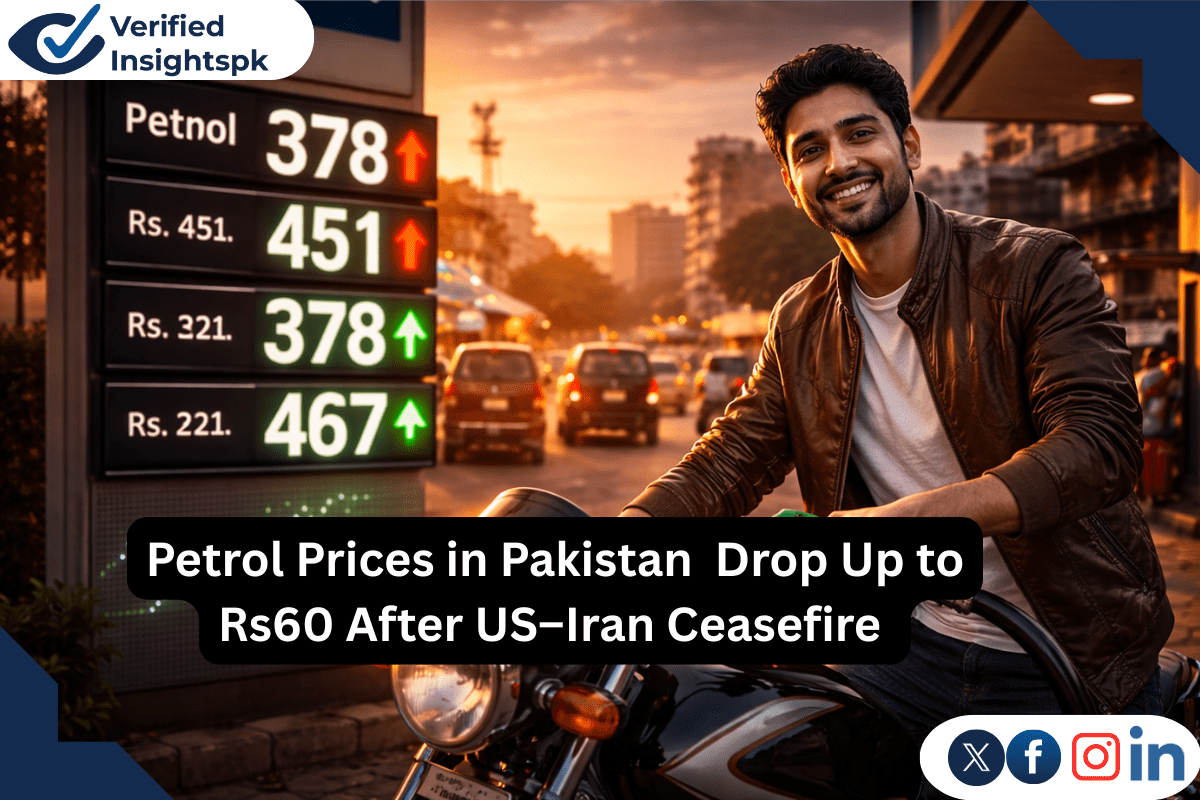
Facing massive public pressure, Prime Minister Shehbaz Sharif addressed the nation in a late-night televised speech on Friday, April 4. He announced an Rs80-per-litre cut in the petrol levy, bringing the price down from Rs458 to Rs378 per litre. The new rate took effect nationwide at midnight Saturday and was set to remain in place for one month.
In his address, PM Shehbaz was candid about the difficulty of the situation. He said that over the past three weeks, he had not considered it appropriate to pass on the daily increase in oil prices to the public, as he was fully aware of the challenges faced by the common man in making ends meet. He added that even major economies were under pressure from rising international oil prices, and that the government had spent 129 billion rupees from national resources to absorb the impact over the previous three weeks.
The rollback was welcomed but widely criticised as insufficient. Critics pointed out that petrol was still more expensive than before the April 3 hike, and that diesel, stuck at Rs520.35 per litre, was not reduced at all.
The Relief Package That Came With It
Alongside the petrol price cut, PM Shehbaz announced a broader relief package targeting the most vulnerable groups in Pakistani society:
For motorbike users: A subsidy of Rs100 per litre, capped at 20 litres per month for three months. Given that millions of Pakistanis rely on bikes as their primary form of transport, this is one of the most direct relief measures announced.
For small farmers: A one-time payment of Rs1,500 per acre to offset higher diesel costs during the harvesting season, a critical move as Pakistan heads into its harvest period.
For the transport sector: Monthly financial assistance ranging from Rs70,000 for freight trucks to Rs80,000 for larger transport vehicles and Rs100,000 for public passenger buses. This aims to prevent transport operators from passing on their own fuel costs to passengers and freight customers.
For railway passengers: Economy-class fares on Pakistan Railways were frozen, meaning the cheapest form of long-distance travel for millions of Pakistanis would not get more expensive.
In response to government austerity, all federal cabinet members will forgo their salaries for six months, up from an earlier plan of two months, with the amount deposited into the national treasury.
State Minister Huzaifa Rehman emphasised that the government would ensure that fuel price reductions also lead to a decrease in the prices of essential commodities. He warned that strict legal action would be taken against profiteers and any trader or businessman who continued to charge old, high rates, using previous fuel prices as an excuse.
Now: The US-Iran Ceasefire Changes Everything
Here is where the story gets even more significant and more hopeful for Pakistan.
On the night of April 7, 2026, Pakistan brokered a historic two-week ceasefire between the United States and Iran. Prime Minister Shehbaz Sharif and Field Marshal Asim Munir directly convinced President Trump to hold back massive military strikes on Iran. In return, Iran agreed to reopen the Strait of Hormuz to international shipping.
The impact on global oil prices was immediate and dramatic. Petroleum product prices fell by 16 percent internationally within hours of the ceasefire announcement. Oil markets, which had been gripped by war-driven panic for six weeks, began to recover rapidly.
PM Shehbaz Sharif described the ceasefire as a “very historic day” for Pakistan and stressed that the positive impact of Pakistan’s diplomatic efforts would be felt by inflation-wary people, as the recent reduction in global oil prices would be passed on to consumers gradually. He added that the cabinet would hold a meeting to discuss further measures to benefit the people.
Now, PM Shehbaz has issued special instructions to concerned ministries to pass on the international oil price benefits directly to the public. The finance and petroleum ministries are reviewing fuel prices and will decide on the reductions after monitoring crude rates over the next two days.
What does this mean for you? It means another round of petrol price cuts is expected very soon, potentially as large as Rs60 per litre, according to reports from ProPakistani.
Current Petrol & Diesel Prices in Pakistan, April 2026
Here is a clear summary of where prices stand right now and where they have been:
| Fuel Type | Before March Hike | After April 3 Hike | Current Price | Expected Soon |
| Petrol (Super) | Rs321.17/litre | Rs458.41/litre | Rs378/litre | Further cut expected |
| High-Speed Diesel | Rs335.86/litre | Rs520.35/litre | Rs520.35/litre | Cut under review |
| Kerosene Oil | Rs176.81/litre | Rs457.80/litre | Rs467.48/litre | Under review |
Prices are officially set by the government and apply nationwide across all petrol stations, whether PSO, Shell, Total, or any other company. OGRA (Oil and Gas Regulatory Authority) reviews and recommends fuel prices twice a month.
Why Does Pakistan’s Petrol Price Go Up and Down So Much?
Many Pakistanis wonder why fuel prices keep changing every two weeks. Here is a simple explanation.
Pakistan imports most of its crude oil. It buys from countries like Saudi Arabia, the UAE, and Oman. When global oil prices go up, because of wars, supply cuts, or political tensions, Pakistan has to pay more to import the same amount of oil. That extra cost is usually passed on to consumers through higher pump prices.
The main factors that affect petrol prices in Pakistan are:
Global crude oil rates. When war breaks out in oil-producing regions like the Middle East, crude prices surge globally, and Pakistan’s import costs rise immediately.
The US dollar rate, Pakistan pays for oil in US dollars. When the rupee weakens against the dollar, even the same global oil price costs more in rupees.
Petroleum levy and taxes: A significant part of what you pay at the pump is government tax. The petroleum levy alone was recently as high as Rs 160 per litre. When the government cut it to Rs80 per litre in April, that’s what made the Rs80 reduction possible.
OGRA recommendations, The Oil and Gas Regulatory Authority calculates a recommended price every two weeks based on current import costs, taxes, and refinery margins, and submits it to the government for approval.
Understanding these factors helps you know why prices go up, and, importantly, when to expect them to come down.
What About the Common Man? Real Impact on Daily Life
Let’s be honest about what these price changes mean in real, everyday terms.
A rickshaw driver like Wahid, earning around Rs1,000 a day, faced an impossible choice when petrol hit Rs458 per litre: buy enough fuel to work, or feed his children. For him, an Rs80 cut is meaningful but not enough. He still pays Rs 57 more per litre than he did in early March.
A farmer preparing for harvest faced diesel at Rs520 per litre, a cost that directly pushes up the price of wheat, rice, and vegetables that reach your plate. The government’s Rs1,500 per acre subsidy is a small step, but the underlying diesel price remains very high.
A family that relies on a small motorcycle for commuting, school runs, and daily errands is somewhat cushioned by the Rs100 per litre motorbike subsidy, but only for 20 litres per month, which may not be enough for heavy users.
The promised price cut, of up to Rs60 per litre, following the ceasefire-driven drop in global oil prices, would bring genuine, broad relief to millions of Pakistanis. Every rupee off the pump price reduces transport costs, which reduces the cost of food, medicine, and everything that is moved by road in Pakistan. That is why this news matters so much beyond just the price at the petrol station.
What the Government Has Promised Next
State Minister Huzaifa Rehman, speaking on ARY News, made three specific commitments on behalf of the government:
First, that the full impact of falling international oil prices will be passed directly to the public, not held back or reduced by taxes or levies.
Second, that strict action will be taken against any business, shop, or trader that uses old petrol prices as an excuse to keep commodity prices high after the fuel price falls.
Third, the government’s top priority right now is to lift the burden of inflation off the common man, and further economic relief is being planned and will be announced in the coming days.
These are strong commitments. Whether they are fulfilled depends on how quickly OGRA processes the new lower global oil costs and whether the government passes on the full reduction or uses part of it to replenish its own revenues through the petroleum levy.
Pakistanis should watch the next OGRA notification carefully.
Verified Insights Pakistan’s View
The petrol price saga of April 2026 is a story in two parts, and Pakistan is still in the middle of it.
The first part was painful: a series of massive price hikes driven by a real global crisis. A government that waited too long to act, and ordinary citizens who bore the full weight of decisions made in distant countries.
The second part is more hopeful: Pakistan’s own diplomacy, the ceasefire it brokered between the US and Iran, has helped bring global oil prices down. That is a direct and tangible benefit to every Pakistani household. PM Shehbaz Sharif now has a genuine opportunity to deliver meaningful, lasting fuel price relief, not just a partial rollback.
The key test will be the next petrol price announcement. If the government passes on the full benefit of falling oil prices, including another Rs50 to Rs60 per litre cut, it will have delivered real relief. If it uses the opportunity to quietly rebuild the petroleum levy revenue it gave up, the public will notice.
The common man has waited long enough. He deserves the full benefit, not just part of it.
Conclusion
The bottom line is this: petrol prices in Pakistan are coming down, and they should come down further in the next few days.
Global oil prices have fallen by over 16% since the US-Iran ceasefire. PM Shehbaz Sharif has given clear orders to pass on the benefits to the public. The Finance and Petroleum Ministries are actively reviewing fuel prices. A cut of up to Rs60 per litre is being discussed.
For millions of Pakistanis, the motorcyclist, the rickshaw driver, the farmer, the shopkeeper, the parent filling a car to take children to school, this is genuinely important news. Fuel prices affect everything in Pakistan: food, transport, electricity, and the cost of running a business.
Watch for the next official OGRA announcement. Share this article with your family and friends so they know their rights and can hold businesses accountable for pricing fairly. And if a shop or transport service near you is still charging the old. High prices after the petrol cut comes into effect, know that the government has promised strict legal action against profiteers.
Relief is on the way. Pakistan earned it through diplomacy, and its people deserve every rupee of it.
Quick Summary: Key Petrol Price Facts
| Event | Date | Detail |
| First price hike | March 2026 | Petrol rose by Rs 55/litre |
| Historic high | April 3, 2026 | Petrol hit Rs458.41 , highest ever |
| Partial rollback | April 4, 2026 | PM cut petrol by Rs80, now Rs378 |
| Diesel unchanged | April 4, 2026 | Diesel stays at Rs520.35 |
| US-Iran ceasefire | April 7, 2026 | Global oil falls 16% overnight |
| Next cut expected | April 8–10, 2026 | Up to Rs60/litre cut under review |
| Motorbike subsidy | Active | Rs100/litre, max 20L/month for 3 months |
| Farmer support | Active | Rs1,500 per acre one-time payment |
Source
- Arab News: Pakistan PM Cuts Petrol Price
- ProPakistani: Govt Likely to Cut Petrol Prices by Rs60
- OGRA Official Fuel Price Notifications
Disclaimer: This article is based on verified information from ARY News, Arab News, ProPakistani, Daily Pakistan, The Nation, PakWheels, and other credible Pakistani and international sources. Fuel prices in Pakistan are revised by the government on a fortnightly basis and can change at any time based on OGRA recommendations. The prices mentioned in this article reflect rates as of April 8, 2026. Always verify the latest rates at official sources, including OGRA or PSO, before making decisions. The “Verified Insights Pakistan’s View” section represents the editorial opinion of this publication only.