





US-Israel War With Iran Escalates: Strait of Hormuz Threat, Tehran Strikes, and Global Shockwaves
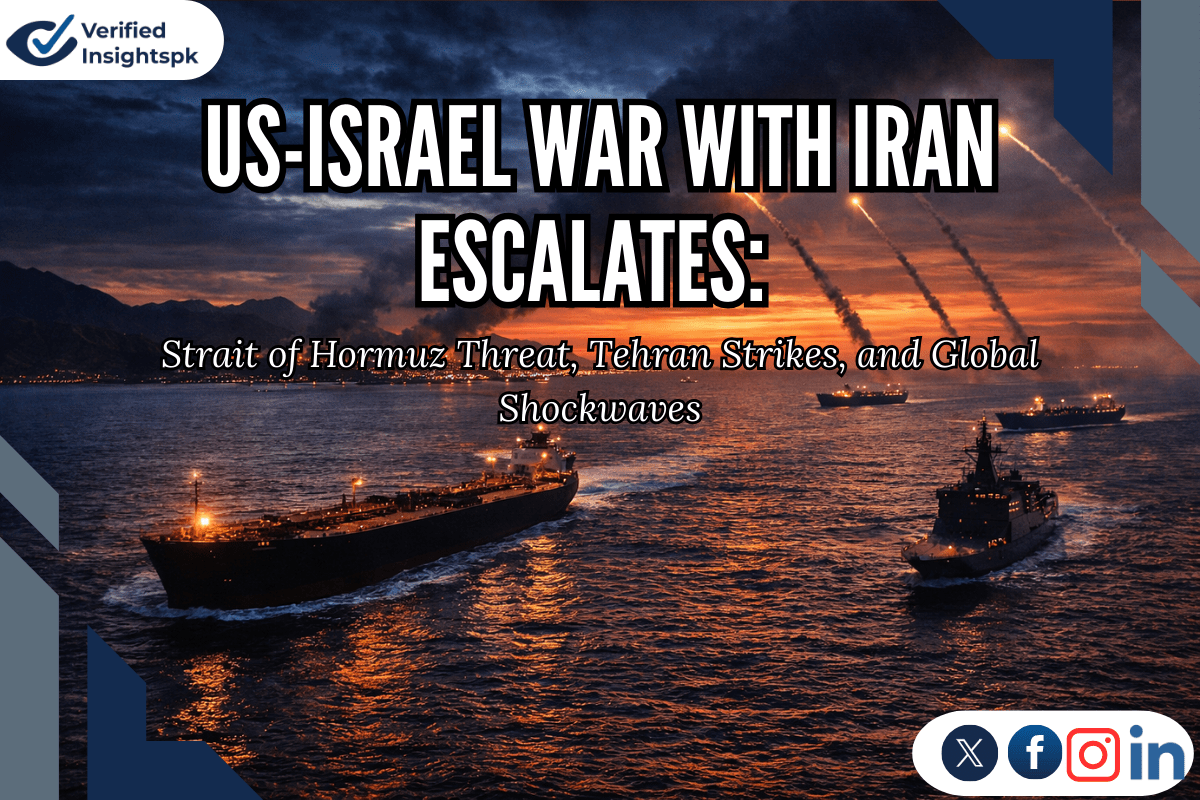
The Middle East is facing one of its most dangerous escalations in decades. The United States and Israel have launched large-scale military operations against Iran, killing Iran’s Supreme Leader, Ayatollah Ali Khamenei, and striking multiple nuclear and military sites. In response, Iran has issued a dramatic warning: it will “set fire” to ships attempting to pass through the Strait of Hormuz, the world’s most critical oil transit route.
Missile exchanges, drone strikes, regional military alerts, embassy attacks, rising oil shipping rates, and international evacuation advisories are now shaping what could become a broader regional conflict.
This article provides a structured, verified analysis of what has happened, why it matters, and what could come next.
What Sparked the Current US-Israel War With Iran?
Joint Strikes on Iranian Nuclear Facilities
According to official US and Israeli statements:
- The United States and Israel launched coordinated strikes on Iran.
- Three nuclear facilities were targeted.
- The operations reportedly killed Supreme Leader Ayatollah Ali Khamenei.
- Israeli forces have continued strikes on Tehran and other locations.
US President Donald Trump described the decision as the “last, best chance” to stop Iran’s regime and prevent nuclear weapon development. He confirmed that large-scale combat operations are ongoing.
Israeli Prime Minister Benjamin Netanyahu defended the strikes, claiming Iran was building underground facilities that would soon be “immune” from future attacks.
US Justification (Pre-Emptive Defense)
US Secretary of State Marco Rubio stated that:
- The US knew Israel was preparing to strike Iran.
- Washington believed Iran would retaliate against US forces.
- Therefore, the US struck “pre-emptively” to reduce potential American casualties.
- Rubio warned that “the hardest hits are yet to come.”
Vice President JD Vance added that the US does not intend to enter a long, multi-year war like Iraq or Afghanistan.
The White House and Congressional leaders described the strikes as defensive and limited in scope.
Please Also read: Trump’s State of the Union 2026: Key Announcements, Iran Tensions, Tariffs, and Political Divisions
Iran’s Immediate Response and Regional Escalation
Missile Launches Toward Israel
Iran fired missiles toward multiple areas of Israel. The Israeli Defense Forces (IDF) confirmed:
- Air defense systems were activated.
- Interceptions occurred over several regions.
- Missile alerts were sent to civilians across Israel.
The exchange marks a significant direct confrontation between the two states.
Drone Attacks Across the Gulf Region
The conflict quickly spread beyond Iran and Israel:
- The US embassy in Riyadh was hit by two drones, causing limited fire damage.
- Explosions were reported in Saudi Arabia’s diplomatic quarter.
- An air base near Dubai used by Australian forces was struck by a drone.
- Amazon Web Services confirmed that two UAE data centers were directly hit by drone strikes, causing structural damage and power disruption.
The US State Department has urged Americans to depart much of the Middle East due to “serious safety risks.”
Also Read: Donald Trump Net Worth 2026, Age, Height, Health, and Latest News
Iran’s Threat to Close the Strait of Hormuz
Why the Strait of Hormuz Matters
The Strait of Hormuz is the most critical oil transit chokepoint in the world:
- Roughly 20% of global oil and gas passes through it.
- It connects the Persian Gulf to international markets.
- It is only about 50 km wide at its narrowest entry and exit points.
Any disruption could severely impact global energy markets.
Iran’s Warning to Global Shipping
An adviser to Iran’s Islamic Revolutionary Guard Corps (IRGC) publicly warned:
- Iran will “set fire” to ships attempting to pass.
- Ships “should not come to this region.”
- Iran may target pipelines and block oil exports.
The rhetoric represents one of the most aggressive threats to global trade routes in recent years.
Global Energy Shock (Oil Shipment Rates Increase)
The market reaction was immediate.
- The cost of hiring a supertanker from the Middle East to China surged above $400,000 per trip.
- That figure nearly doubled compared to the previous week.
- These vessels can carry up to two million barrels of crude oil.
Higher shipping costs signal:
- Increased risk premiums.
- Insurance hikes.
- Fear of maritime attacks.
Energy analysts warn that prolonged instability could:
- Push global oil prices higher.
- Disrupt supply chains.
- Trigger inflationary pressure worldwide.
Civilian Impact Inside Iran and the Region
Damage in Tehran
Strikes have hit multiple areas of Tehran, including:
- Government facilities.
- State broadcaster premises (IRIB).
- Areas near historical and cultural sites.
Iranian state media reported damage to Golestan Palace, a UNESCO World Heritage Site.
The targeting of media infrastructure and nearby civilian areas raises questions about collateral damage.
Also Read: Why Are Pakistan and Afghanistan Fighting? Inside the Escalation, Root Causes, and Future Scenarios
School Strike Allegations
Iranian officials reported that:
- A girls’ school in Minab was struck.
- Dozens of civilians, including children, were killed.
- The site was reportedly near an IRGC base.
US officials say the Pentagon is investigating whether it was a US strike. Secretary Rubio stated that the US would not deliberately target a school.
The incident remains under review.
Israel Expands Operations Beyond Iran
Israel has also launched strikes on:
- Hezbollah targets in Lebanon.
- Military infrastructure is believed to be linked to Iranian influence.
Lebanese health officials report:
- 52 people killed.
- Hundreds displaced in Beirut.
- Widespread evacuations.
Israel has warned that operations will continue until threats are “fully removed.”
This widens the conflict beyond a bilateral US-Iran confrontation.
Regional Military and Diplomatic Reactions
United Kingdom’s Position
UK Prime Minister Keir Starmer stated:
- The UK deliberately chose not to join the US Israel war iran.
- Britain does not support “regime change from the skies.”
Australia’s Position
Australia confirmed:
- Drone strike damage at Al Minhad Air Base.
- No Australian casualties.
- Continued support for preventing Iran from obtaining nuclear weapons.
United States Domestic Position
Congressional leaders described the operation as:
- Defensive.
- Limited.
- Short-term.
However, political debate is intensifying over:
- The legal justification.
- The scope of future operations.
- Potential escalation risks.
Strategic Implications of Supreme Leader Khamenei’s Death
The reported killing of Ayatollah Ali Khamenei dramatically shifts Iran’s political landscape.
Key questions now include:
- Who assumes leadership?
- Will there be regime fragmentation?
- Could internal power struggles emerge?
- Will hardliners escalate conflict further?
Iran’s political structure blends religious authority and military influence. The IRGC remains a powerful actor and may play a decisive role in shaping Iran’s next move.
Economic Fallout Beyond Oil
The conflict is affecting more than energy markets.
Technology Infrastructure Disruption
Amazon Web Services confirmed:
- Structural damage to data centers in the UAE.
- Power disruptions.
- Advisories urging customers to back up data.
Damage to cloud infrastructure can disrupt:
- E-commerce.
- Financial services.
- Government systems.
- Communications platforms.
Aviation and Travel Crisis
Passengers arriving in London from Abu Dhabi described:
- Missiles flying overhead.
- Hotel evacuations.
- Drone interceptions.
- Panic and uncertainty.
Airspace risks could:
- Disrupt global flight routes.
- Increase ticket prices.
- Force airlines to reroute.
Is The US Israel war Iran a Wider Regional War Likely?
Factors Pushing Toward Escalation
- Iran’s threats to close the Strait of Hormuz.
- Missile exchanges with Israel.
- Drone strikes across the Gulf states.
- Hezbollah involvement in Lebanon.
- US promises of “harder hits” to come.
Factors Limiting Escalation
- US insistence on avoiding multi-year war.
- Global economic risk.
- Diplomatic pressure.
- Energy market vulnerability.
- Fear of uncontrollable regional spillover.
Military analysts suggest that while limited strikes may continue, a full regional war would carry catastrophic economic consequences.
What Happens Next? Possible Scenarios After US Israel war Iran
-
Controlled Military Escalation
Targeted strikes continue, but Hormuz remains partially open under heavy naval presence.
-
Strait of Hormuz Closure
Iran attempts enforcement, triggering multinational naval intervention and severe oil price spikes.
-
Regional Proxy Expansion
Hezbollah, militias, and aligned groups intensify activity across Lebanon, Iraq, and Syria.
-
Diplomatic Backchannel De-Escalation
International mediation leads to reduced strikes and negotiated containment.
Why This Conflict Matters Globally
This is not just a Middle East crisis. It affects:
- Global oil supply.
- Shipping insurance markets.
- Inflation.
- Technology infrastructure.
- Geopolitical stability.
- Refugee flows.
- Energy security in Europe and Asia.
The Strait of Hormuz alone makes this one of the most strategically sensitive confrontations in modern history.
Last Wordict
However, the US Israel war strikes on Iran and Tehran’s retaliation mark a historic turning point.
The reported death of Iran’s Supreme Leader, direct missile exchanges, drone attacks across Gulf states, threats to global oil shipping, and mounting civilian casualties all signal a conflict that could reshape regional order.
While Washington insists this will not become another prolonged war, and Israel frames its actions as necessary pre-emption, Iran’s warnings over the Strait of Hormuz introduce an unpredictable economic weapon.
The world now watches a fragile balance:
Escalation could spiral quickly.
Restraint could stabilize markets and security.
The coming days will determine whether this remains a limited confrontation or expands into a defining global crisis.
VerifiedInsightsPK Point of View
At VerifiedInsightsPK, our analysis of the US Israel war Iran remains grounded in verified reporting and strategic context. The current escalation is not just a military confrontation; it is a geopolitical shock with economic consequences that extend far beyond the Middle East.
The threat to the Strait of Hormuz elevates this crisis from a regional security matter to a global energy emergency. However, despite strong rhetoric and visible military exchanges, both Washington and Tehran appear aware of the catastrophic cost of prolonged war.
Our assessment:
- Short-term escalation is likely.
- Full-scale regional war remains possible but not inevitable.
- Energy markets and shipping lanes will remain volatile.
- Diplomatic channels may intensify quietly behind the scenes.
The coming weeks will determine whether this becomes a contained confrontation or a defining geopolitical rupture of the decade.
Disclaimer
This article is based on verified reporting from publicly available international news sources at the time of writing. Conflict situations are fluid and rapidly evolving. Some details, including casualty figures and military claims, may change as further investigations are conducted. This publication does not independently verify classified military operations or battlefield intelligence.